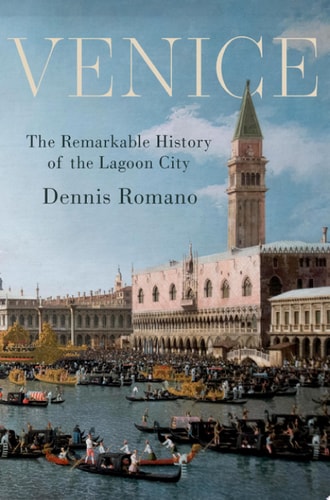
Venice: The Remarkable History of the Lagoon City
0
0
As an Amazon Associate and affiliate partner, Menrva Books earns from qualifying purchases. Learn more
Author Description
A sweeping and comprehensive history of Venice--from its formation in the early Middle Ages to the present day--that traces its evolution as a city, city-state, regional power, and overseas empire.No city stirs the imagination more than Venice. From the richly ornamented palaces emerging from the waters of the Grand Canal to the dazzling sites of Piazza San Marco, visitors and residents alike sense they are entering, as fourteenth-century poet Petrarch remarked, "another world." During the Middle Ages and Renaissance, Venice was celebrated as a model republic in an age of monarchs. In the seventeenth and eighteenth centuries, it became famous for its freewheeling lifestyle characterized by courtesans, casinos, and Carnival. When the city fell on hard times following the collapse of the Republic in 1797, a darker vision of Venice as a place of decay, disease, and death took hold. Today tourists from around the globe flock to the world heritage site as rising sea levels threaten its very foundations.This comprehensive account reveals the adaptations to its geographic setting that have been a constant feature of living on water from Venice's origins to the present. It examines the lives of the women and men, noble and common, rich and poor, Christian, Jew, and Muslim, who built not only the city but also its vast empire that stretched from Northern Italy to the eastern Mediterranean. It details the urban transformations that Venice underwent in response to environmental vulnerability, industrialization, and mass tourism. Alongside the city's commercial prominence has been its dramatically changing political role, including its power as a city-state, regional stronghold, and overseas empire, as well as its impact on the development of fascism. Throughout, Dennis Romano highlights the city's cultural achievements in architecture, painting, and music, particularly opera.This richly illustrated volume offers a stunning portrait of this most singular of cities.
Menrva's Summary
THE THESIS
How did a city built upon a fragile lagoon environment evolve from a medieval settlement into a dominant maritime empire and eventually a global cultural icon? Dennis Romano, a professor of history specializing in Renaissance Italy, utilizes extensive archival research and historical analysis to construct a chronological framework. He argues that Venice's identity is defined by its constant adaptation to environmental constraints, shifting political power, and the diverse social strata that inhabited its borders over centuries.
THE SCOPE MAP
What You Will Find
- A chronological survey spanning from the early Middle Ages to the contemporary era.
- Analysis of urban development in response to environmental and industrial pressures.
- Examination of the social history of various demographics, including nobles, commoners, and religious minorities.
Scope Limits
- The text does not provide a granular day-to-day political chronicle of every Venetian doge.
- It does not focus exclusively on art history, though cultural achievements are discussed as part of the broader social context.
THE AUTHORITY PERSPECTIVE
Historians and reviewers frequently note the accessibility of the prose despite the breadth of the historical period covered. Experts highlight this as a balanced, comprehensive introduction for those seeking to understand the structural and social evolution of the Venetian state.
Page Count:
800
Publication Date:
2024-01-01
Publisher:
Oxford University Press
ISBN-10:
0190859989
ISBN-13:
9780190859985
History
Italy
Cultural History
Histoire
Urban History
European History
Civilisation
Italy history
Community Tags
Other Editions(2)

Similar Books









Reader Comments
Share Your Thoughts
No comments yet. Be the first to share your thoughts!