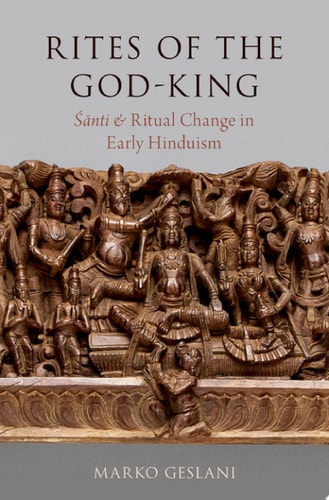
Rites of the God-king
0
0
As an Amazon Associate and affiliate partner, Menrva Books earns from qualifying purchases. Learn more
Author Description
Scholars Of Vedic Religion Have Long Recognized The Centrality Of Ritual Categories To Indian Thought. There Have Been Few Successful Attempts, However, To Bring The Same Systematic Rigor Of Vedic Scholarship To Bear On Later Hindu Ritual. Excavating The Deep History Of A Prominent Ritual Category In Classical Hindu Texts, Geslani Traces The Emergence Of A Class Of Rituals Known As Santi, Or Appeasement. This Ritual, Intended To Counteract Ominous Omens, Developed From The Intersection Of The Fourth Veda - The Oft-neglected Atharvaveda - And The Emergent Tradition Of Astral Science (jyotisastra) Sometime In The Early First Millennium, Ce. Its Development Would Come To Have Far-reaching Consequences On The Ideal Ritual Life Of The King In Early-medieval Brahmanical Society. The Mantric Transformations Involved In The History Of Santi Led To The Emergence Of A Politicized Ritual Culture That Could Encompass Both Traditional Vedic And Newer Hindu Performers And Practices. From Astrological Appeasement To Gift-giving, Coronation, And Image Worship, Rites Of The God-king Chronicles The Multiple Lives And Afterlives Of A Single Ritual Mode, Unveiling The Always-inventive Work Of The Priesthood To Imagine And Enrich Royal Power. Along The Way, Geslani Reveals The Surprising Role Of Astrologers In Hindu History, Elaborates Conceptions Of Sin And Misfortune, And Forges New Connections Between Medieval Texts And Modern Practices. In A Work That Details Ritual Forms That Were Dispersed Widely Across Asia, He Concludes With A Reflection On The Nature Of Orthopraxy, Ritual Change, And The Problem Of Presence In The Hindu Tradition.
Menrva's Summary
THE THESIS
How did the ritual category of Santi, or appeasement, evolve from Vedic roots to become a central mechanism for legitimizing royal power in early-medieval Hindu society? Marko Geslani, a scholar of South Asian religions, utilizes a rigorous analysis of classical Hindu texts and the intersection of the Atharvaveda with early astral science (jyotisastra) to map this development. He argues that the transformation of these rituals allowed the priesthood to integrate traditional Vedic practices with emerging Hindu traditions, thereby creating a flexible, politicized framework for royal authority. By examining the history of Santi, Geslani demonstrates how ritual innovation served as a primary tool for navigating concepts of sin, misfortune, and political legitimacy.
THE SCOPE MAP
What You Will Find
- Historical analysis of the Santi ritual category from the early first millennium CE.
- Examination of the integration between the Atharvaveda and astral science.
- Case studies on coronation, gift-giving, and image worship as political tools.
- Theoretical discussion on the nature of orthopraxy and ritual change.
Scope Limits
- The study focuses primarily on Brahmanical society and does not provide an exhaustive survey of all regional folk variations of these rites.
- The analysis is restricted to the development of the Santi category and does not cover the entirety of Hindu ritual history.
THE AUTHORITY PERSPECTIVE
Scholars in the field of South Asian religious studies identify this work as a significant contribution to the understanding of ritual evolution and the intersection of politics and religion. Readers frequently note the academic density of the prose, which requires a foundational knowledge of Vedic and classical Hindu traditions to fully appreciate the author's arguments.
Page Count:
368
Publication Date:
2018-01-01
Publisher:
Oxford University Press
ISBN-10:
0190862890
ISBN-13:
9780190862893
Religion
History
Hinduism
Political History
Ritual Studies
Asian Studies
Community Tags
Similar Books