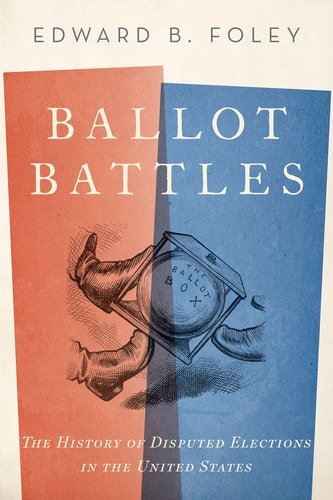
Ballot Battles: The History of Disputed Elections in the United States
0
0
As an Amazon Associate and affiliate partner, Menrva Books earns from qualifying purchases. Learn more
Author Description
The 2000 presidential race resulted in the highest-profile ballot battle in over a century. But it is far from the only American election determined by a handful of votes and marred by claims of fraud. Since the founding of the nation, violence frequently erupted as the votes were being counted, and more than a few elections produced manifestly unfair results. Despite America's claim to be the world's greatest democracy, its adherence to the basic tenets of democratic elections-the ability to count ballots accurately and fairly even when the stakes are high-has always been shaky. A rigged gubernatorial election in New York in 1792 nearly ended in calls for another revolution, and an 1899 gubernatorial race even resulted in an assassination. Though acts of violence have decreased in frequency over the past century, fairness and accuracy in ballot counting nonetheless remains a basic problem in American political life.In Ballot Battles, Edward Foley presents a sweeping history of election controversies in the United States, tracing how their evolution generated legal precedents that ultimately transformed how we determine who wins and who loses. While weaving a narrative spanning over two centuries, Foley repeatedly returns to an originating event: because the Founding Fathers despised parties and never envisioned the emergence of a party system, they wrote a constitution that did not provide clear solutions for high-stakes and highly-contested elections in which two parties could pool resources against one another. Moreover, in the American political system that actually developed, politicians are beholden to the parties which they represent - and elected officials have typically had an outsized say in determining the outcomes of extremely close elections that involve recounts. This underlying structural problem, more than anything else, explains why intense ballot battles that leave one side feeling aggrieved will continue to occur for the foreseeable future.
Menrva's Summary
THE THESIS
This book investigates the historical origins and structural vulnerabilities of the American electoral system that lead to contested outcomes. Edward Foley, a law professor and election expert, utilizes historical records and legal analysis to argue that the Founding Fathers' failure to anticipate a two-party system created a constitutional vacuum. He posits that the reliance on partisan officials to resolve close elections ensures that disputes will remain a recurring feature of the American political landscape.
THE SCOPE MAP
What You Will Find
- A chronological survey of disputed U.S. elections from 1792 to the modern era.
- Analysis of legal precedents established by high-stakes recounts and contested results.
- Examination of the structural role of political parties in election administration.
Scope Limits
- The text does not provide a comprehensive guide to current state-by-state election laws.
- It does not focus on international comparative election systems.
THE AUTHORITY PERSPECTIVE
Experts recognize this work as a foundational text for understanding the intersection of constitutional law and electoral history. Readers frequently note the academic rigor of the prose, which balances historical narrative with complex legal theory.
Page Count:
496
Publication Date:
2019-06-01
Publisher:
Oxford University Press
ISBN-10:
0190865954
ISBN-13:
9780190865955
History
Law
Election law
Government
Elections
United States
Community Tags
Similar Books