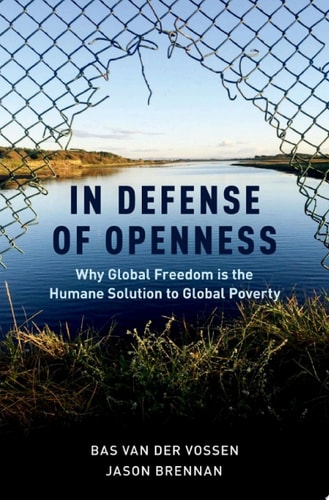
In Defense of Openness: Why Global Freedom Is the Humane Solution to Global Poverty
0
0
As an Amazon Associate and affiliate partner, Menrva Books earns from qualifying purchases. Learn more
Author Description
The topic of global justice has long been a central concern within political philosophy and political theory, and there is no doubt that it will remain significant given the persistence of poverty on a massive scale and soaring global inequality. Yet, virtually every analysis in the vast literature of the subject seems ignorant of what developmental economists, both left and right, have to say about the issue. In Defense of Openness illuminates the problem by stressing that that there is overwhelming evidence that economic rights and freedom are necessary for development, and that global redistribution tends to hurt more than it helps. Bas van der Vossen and Jason Brennan instead ask what a theory of global justice would look like if it were informed by the facts that mainstream development and institutional economics have brought to light. They conceptualize global justice as global freedom and insist we can help the poor-and help ourselves at the same time-by implementing open borders, free trade, the strong protection of individual freedom, and economic rights and property for all around the world. In short, they work from empirical, consequentialist grounds to advocate for the market society as a model for global justice. A spirited challenge to mainstream political theory from two leading political philosophers, In Defense of Openness offers a new approach to global justice: We don't need to "save" the poor. The poor will save themselves, if we would only get out of their way and let them.
Menrva's Summary
THE THESIS
This book investigates whether global justice is best achieved through economic freedom and open borders rather than traditional redistributionist policies. Authors Bas van der Vossen and Jason Brennan, both established scholars in political philosophy, synthesize findings from developmental and institutional economics to challenge mainstream theories of global justice. They argue that the most effective way to alleviate poverty is to remove barriers to trade and migration, thereby empowering individuals to improve their own economic conditions through market participation.
THE SCOPE MAP
What You Will Find
- Analysis of the relationship between economic rights and national development
- Arguments for open borders and free trade as moral imperatives
- Empirical evidence regarding the failure of global redistribution models
- A framework for global justice based on consequentialist ethics
Scope Limits
- The text does not provide a detailed historical account of specific colonial economic policies
- It does not offer a comprehensive critique of non-market-based social welfare systems within individual nations
THE AUTHORITY PERSPECTIVE
Scholars and critics frequently note the book's departure from traditional political theory by centering empirical economic data in its philosophical arguments. Experts highlight this as a provocative text that forces a re-evaluation of the intersection between moral philosophy and developmental economics.
Page Count:
236
Publication Date:
2018-01-01
Publisher:
Oxford University Press
ISBN-10:
0190876115
ISBN-13:
9780190876111
Economics
Political Philosophy
Political Theory
Public Policy
Global Poverty
Community Tags
Similar Books