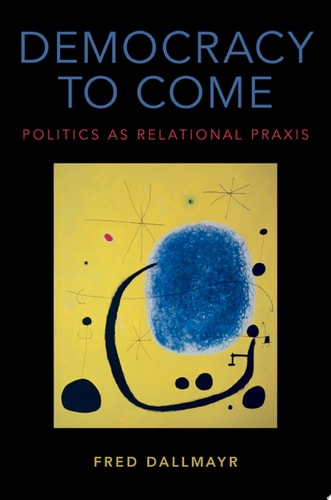
Democracy to Come: Politics as Relational Praxis
0
0
As an Amazon Associate and affiliate partner, Menrva Books earns from qualifying purchases. Learn more
Author Description
In this book Fred Dallmayr lays the groundwork for a new understanding of democracy. He argues that democracy is not a stable system anchored in a manifest authority (like monarchy), but is sustained by the recessed and purely potential rule of the "people". Hence, democracy has to constantly reinvent itself, resembling theologically a creatio continua. Like one of Calder's mobiles, democracy for him involves three basic elements that must be balanced constantly: the people, political leaders, and policy goals. Where this balance is disrupted, democracy derails into populism, Bonapartism, or messianism. Given this need for balance, democratic politics is basically a "relational praxis."In our globalizing age, democracy cannot be confined domestically. Dallmayr rejects the idea that it can be autocratically imposed abroad through forced regime change, or that the dominant Western model can simply be transferred elsewhere. In this respect, he challenges the equation of democracy with the pursuit of individual or collective self-interest, insisting that other, more ethical conceptions are possible and that different societies should nurture democracy with their own cultural resources. Providing examples, he discusses efforts to build democracy in the Middle East, China, and India (respectively with Islamic, Confucian and Hindu resources). In the end, Dallmayr's hope is for a "democracy to come", that is, a cosmopolitan community governed not by hegemonic force but by the spirit of equality and mutual respect.
Menrva's Summary
THE THESIS
Fred Dallmayr investigates the core question of how democracy can be reconceptualized as a dynamic, relational praxis rather than a static system of governance. Drawing on his extensive background in political philosophy, Dallmayr argues that democracy is a continuous process of creation that requires a delicate, ongoing balance between the people, political leadership, and policy objectives. He posits that when this equilibrium fails, political systems inevitably devolve into populism or authoritarianism, and he advocates for a cosmopolitan approach that respects diverse cultural foundations.
THE SCOPE MAP
What You Will Find
- A theoretical framework defining democracy as a relational praxis.
- Comparative analysis of democratic development in the Middle East, China, and India.
- Critiques of forced regime change and the imposition of Western democratic models.
Scope Limits
- The text does not provide a prescriptive policy manual for specific legislative reforms.
- It does not offer a comprehensive history of every global democratic movement.
THE AUTHORITY PERSPECTIVE
Scholars and political theorists frequently note the dense, philosophical nature of Dallmayr's prose, which requires a strong foundation in political thought to fully grasp. Experts often highlight this work as a significant contribution to the discourse on post-Western democratic theory and global pluralism.
Page Count:
192
Publication Date:
2017-01-01
Publisher:
Oxford University Press
ISBN-10:
0190670991
ISBN-13:
9780190670993
Political Theory
Democracy
Comparative Politics
Political Philosophy
Community Tags
Similar Books