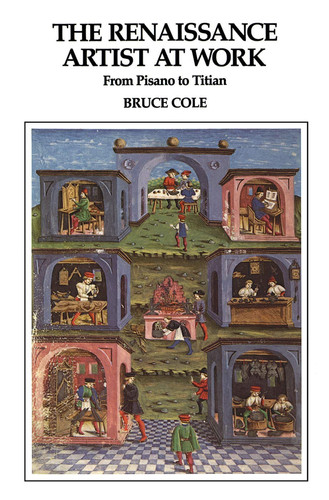
The Renaissance Artist at Work: From Pisano to Titian
0
0
As an Amazon Associate and affiliate partner, Menrva Books earns from qualifying purchases. Learn more
Author Description
This text gives the necessary background for the study and appreciation of Italian painting and sculpture from about 1250 to 1550. It tells how the artists learned their craft, the organization of their workshops, and the guilds they belonged to; how their customers or patrons treated them and where their work was displayed - churches, civic buildings, or private homes. The book discusses how art was made - tempera, oil, panel, canvas, fresco and also surveys the characteristic types of Renaissance art - altar pieces, portraits, tombs, busts, doors fountains, medals, etc.
Menrva's Summary
THE THESIS
This text investigates the material, social, and professional conditions that shaped the production of Italian art between 1250 and 1550. Bruce Cole, a distinguished scholar of Italian Renaissance art, utilizes historical records and surviving artifacts to reconstruct the daily reality of the artist's workshop. He argues that understanding the technical constraints and the patron-artist relationship is essential for a comprehensive appreciation of the period's aesthetic output.
THE SCOPE MAP
What You Will Find
- Analysis of workshop organization, guild structures, and artistic apprenticeship systems.
- Technical surveys of media including tempera, oil, fresco, and sculpture materials.
- Examination of the socio-economic relationship between artists and their patrons.
- Categorization of Renaissance art forms such as altarpieces, portraiture, and civic monuments.
THE AUTHORITY PERSPECTIVE
The subject matter points to a foundational, academic introduction suitable for students and enthusiasts of art history. The framing suggests a methodical, evidence-based approach that prioritizes the practical mechanics of creation over abstract stylistic theory.
Page Count:
216
Publication Date:
1983-01-01
Publisher:
Harper & Row
ISBN-10:
0006430902
ISBN-13:
9780006430902
History
Renaissance
Italian Art
Art History
Art Techniques
Community Tags
Other Editions(4)


Similar Books