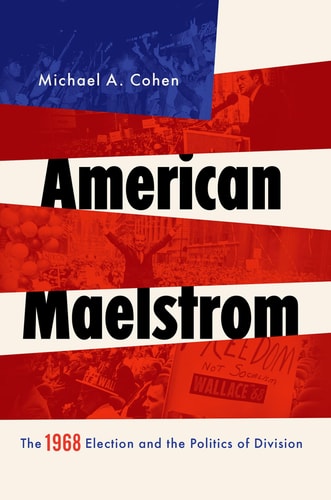
American Maelstrom: The 1968 Election and the Politics of Division
0
0
As an Amazon Associate and affiliate partner, Menrva Books earns from qualifying purchases. Learn more
Author Description
In his presidential inaugural address of January 1965, Lyndon B. Johnson offered an uplifting vision for America, one that would end poverty and racial injustice. Elected in a landslide over the conservative Republican Barry Goldwater and bolstered by the so-called liberal consensus, economic prosperity, and a strong wave of nostalgia for his martyred predecessor, John F. Kennedy, Johnson announced the most ambitious government agenda in decades. Three years later, everything had changed. Johnson's approval ratings had plummeted; the liberal consensus was shattered; the war in Vietnam splintered the nation; and the politics of civil rights had created a fierce white backlash. A report from the National Committee for an Effective Congress warned of a "national nervous breakdown."The election of 1968 was immediately caught up in a swirl of powerful forces, and the nine men who sought the nation's highest office that year attempted to ride them to victory-or merely survive them. On the Democratic side, Eugene McCarthy energized the anti-war movement; George Wallace spoke to the working-class white backlash; Robert Kennedy took on the mantle of his slain brother. Entangled in Vietnam, Johnson, stunningly, opted not to run again, scrambling the odds. On the Republican side, 1968 saw the vindication of Richard Nixon, who outhustled Nelson Rockefeller, Ronald Reagan, and George Romney by navigating between the conservative and moderate wings of the Republican Party. The assassinations of the first Martin Luther King, Jr., and then Kennedy, seemed to push the country to the brink of chaos, a chaos reflected in the Democratic Convention in Chicago, a televised horror show. Vice President Hubert Humphrey emerged as the nominee, and, finally liberating himself from Johnson's grip, nearly overcame the lead long enjoyed by Nixon, who, by exploiting division and channeling the national yearning for order, would be the last man standing.In American Maelstrom, Michael A. Cohen capt
Menrva's Summary
THE THESIS
This book investigates how the tumultuous events of 1968 fundamentally fractured the American political consensus and reshaped the nation's electoral landscape. Michael A. Cohen, a political analyst and historian, examines the collapse of Lyndon B. Johnson's liberal agenda and the subsequent rise of a new, divisive political order. By analyzing the strategies of the nine primary candidates, the author argues that the 1968 election served as the crucible for modern American polarization.
THE SCOPE MAP
What You Will Find
- A detailed analysis of the 1968 presidential election cycle.
- Examination of the Vietnam War's impact on domestic policy and public sentiment.
- Profiles of key political figures including Richard Nixon, Hubert Humphrey, Robert Kennedy, and George Wallace.
- An account of the social unrest surrounding the civil rights movement and the Democratic National Convention.
Scope Limits
- The text does not provide a comprehensive history of the entire 1960s decade.
- It focuses primarily on electoral politics rather than deep-dive sociological analysis of the counterculture movement.
THE AUTHORITY PERSPECTIVE
Historians and political scientists frequently cite this work as a definitive account of the 1968 election's long-term impact on American governance. Readers often note the author's ability to synthesize complex political maneuvering into a coherent narrative of national transformation.
Page Count:
448
Publication Date:
2018-06-01
Publisher:
Oxford University Press
ISBN-10:
0190878037
ISBN-13:
9780190878030
History
Elections
United States
20th Century
Political Biography
Community Tags
Similar Books