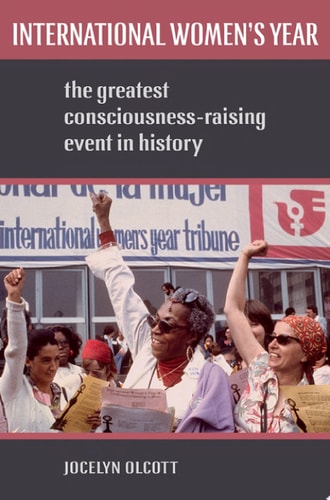
International Women's Year: The Greatest Consciousness-Raising Event in History
0
0
As an Amazon Associate and affiliate partner, Menrva Books earns from qualifying purchases. Learn more
Author Description
Amid the geopolitical and social turmoil of the 1970s, the United Nations declared 1975 as International Women's Year. The capstone event, a two-week conference in Mexico City, was dubbed by organizers and journalists as "the greatest consciousness-raising event in history." The event drew an all-star cast of characters, including Soviet cosmonaut Valentina Tereshkova, Iranian Princess Ashraf Pahlavi, and US feminist Betty Friedan, as well as a motley array of policymakers, activists, and journalists. International Women's Year, the first book to examine this critical moment in feminist history, starts by exploring how organizers juggled geopolitical rivalries and material constraints amid global political and economic instability. The story then dives into the action in Mexico City, including conflicts over issues ranging from abortion to Zionism. The United Nations provided indispensable infrastructure and support for this encounter, even as it came under fire for its own discriminatory practices. While participants expressed dismay at levels of discord and conflict, Jocelyn Olcott explores how these combative, unanticipated encounters generated the most enduring legacies, including women's networks across the global south, greater attention to the intersectionalities of marginalization, and the arrival of women's micro-credit on the development scene.This watershed moment in transnational feminism, colorfully narrated in International Women's Year, launched a new generation of activist networks that spanned continents, ideologies, and generations.
Menrva's Summary
THE THESIS
This book investigates how the 1975 United Nations International Women's Year conference served as a pivotal, albeit contentious, catalyst for transnational feminist activism and global policy shifts. Jocelyn Olcott, a historian specializing in gender and politics, utilizes archival research and primary accounts to reconstruct the Mexico City conference. She argues that the friction generated by competing geopolitical agendas and ideological divides actually fostered the creation of enduring international networks and new development paradigms.
THE SCOPE MAP
What You Will Find
- Analysis of the 1975 United Nations International Women's Year conference in Mexico City.
- Examination of the intersection between Cold War geopolitics and feminist activism.
- Documentation of the emergence of women's micro-credit initiatives in global development.
- Profiles of key figures including Valentina Tereshkova, Ashraf Pahlavi, and Betty Friedan.
Scope Limits
- The text focuses primarily on the 1975 event and its immediate aftermath rather than a comprehensive history of the entire UN Decade for Women.
- It does not provide an exhaustive biography of all participants, focusing instead on their roles within the conference framework.
THE AUTHORITY PERSPECTIVE
Scholars and historians identify this work as a significant contribution to the study of transnational feminism and the history of international organizations. Readers frequently note the author's ability to balance complex geopolitical analysis with the personal narratives of the diverse participants involved in the event.
Page Count:
353
Publication Date:
2017-01-01
Publisher:
Oxford University Press
ISBN-10:
0190649984
ISBN-13:
9780190649982
History
World Civilization
Feminism
American History
Military History
20th Century
International relations
Special Topics
Women
Womens Studies
Womens rights
Community Tags
Other Editions(3)
Similar Books

Reader Comments
Share Your Thoughts
No comments yet. Be the first to share your thoughts!