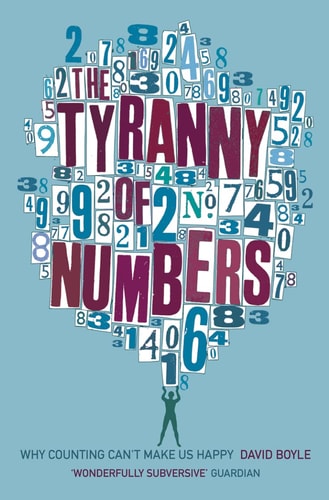
The Tyranny of Numbers: Why Counting Can't Make Us Happy
0
0
As an Amazon Associate and affiliate partner, Menrva Books earns from qualifying purchases. Learn more
Author Description
Never before have we attempted to measure as much as we do today. Why are we so obsessed with numbers? What can they really tell us?Too often we try to quantify what can’t actually be measured. We count people, but not individuals. We count exam results rather than intelligence, benefit claimants instead of poverty. The government has set itself 10,000 new targets. Politicians pack their speeches with skewed crime rates are either rising or falling depending on who is doing the counting.We are in a world in which everything designed only to be measured. If it can’t be measured it can be ignored.But the big problem is what numbers don’t tell you. They won’t interpret. They won’t inspire, and they won’t tell you precisely what causes what.In this passionately argued and thought-provoking book, David Boyle examines our obsession with numbers. He reminds us of the danger of taking numbers so seriously at the expense of what is non-measurable, intuition, creativity, imagination, happiness…Counting is a vital human skill. Yardsticks are a vital tool. As long as we remember how limiting they are if we cling to them too closely.Americans who claim to have been abducted by aliens = 3.7 millionAverage time spent by British people in traffic jams every year = 11 daysNumber of Americans shot by children under six between 1983 and 1993 = 138, 490
Menrva's Summary
THE THESIS
This book investigates the societal obsession with quantification and the inherent limitations of using numerical data to measure complex human experiences. David Boyle, a writer and fellow at the New Economics Foundation, critiques the modern tendency to prioritize measurable metrics over qualitative values like intuition, creativity, and happiness. He argues that the reliance on targets and statistics often obscures the reality of individual human lives and leads to a distorted understanding of social issues.
THE SCOPE MAP
What You Will Find
- Analysis of the political and bureaucratic reliance on performance targets and statistical indicators.
- Examination of the disconnect between quantitative data and qualitative human outcomes such as poverty and intelligence.
- Case studies illustrating how skewed statistics are used to manipulate public perception.
- Philosophical arguments regarding the necessity of intuition and imagination in a data-driven society.
THE AUTHORITY PERSPECTIVE
The text provides a critical, accessible examination of the dangers of technocratic governance and the reductionist nature of modern metrics. It serves as a cautionary analysis for readers interested in the intersection of social policy, philosophy, and the limits of empirical measurement.
Page Count:
256
Publication Date:
2001-01-01
Publisher:
Flamingo
ISBN-10:
0006531997
ISBN-13:
9780006531999
Philosophy
Politics
Economics
Social Science
Sociology
Community Tags
Similar Books