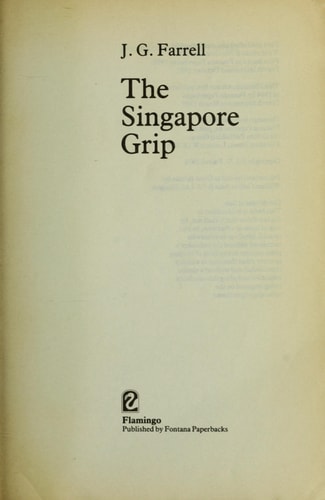
The Singapore Grip
0
0
As an Amazon Associate and affiliate partner, Menrva Books earns from qualifying purchases. Learn more
Author Description
Singapore, 1939: life on the eve of World War II just isn't what it used to be for Walter Blackett, head of British Singapore's oldest and most powerful firm. No matter how forcefully the police break one strike, the natives go on strike somewhere else. His daughter keeps entangling herself with the most unsuitable beaus, while her intended match, the son of Blackett's partner, is an idealistic sympathizer with the League of Nations and a vegetarian. Business may be booming—what with the war in Europe, the Allies are desperate for rubber and helpless to resist Blackett's price-fixing and market manipulation—but something is wrong. No one suspects that the world of the British Empire, of fixed boundaries between classes and nations, is about to come to a terrible end. A love story and a war story, a tragicomic tale of a city under siege and a dying way of life, The Singapore Grip completes the “Empire Trilogy” that began with Troubles and the Booker prize-winning Siege of Krishnapur.
Menrva's Summary
THE PULSE
As the British Empire faces its inevitable collapse in 1939 Singapore, a powerful merchant struggles to maintain his commercial dominance amidst rising social unrest and the looming threat of Japanese invasion. Walter Blackett, the head of a prominent trading firm, attempts to navigate the shifting political landscape while managing his daughter's romantic entanglements and his partner's inconvenient idealism. The narrative operates as a tragicomic examination of colonial hubris, utilizing a third-person perspective to contrast the detached lives of the British elite with the encroaching reality of global conflict. The story is constrained by the rigid social hierarchies of the era and the impending physical destruction of the city, forcing characters to confront the fragility of their status.
INSIDE THE PAGES
- Detailed depiction of colonial social structures and class divisions in 1939 Singapore
- Satirical treatment of British commercial interests and price-fixing practices
- Integration of historical events, including the fall of Singapore and the Japanese invasion
- Exploration of the ideological conflict between imperialist pragmatism and humanitarian idealism
- Use of tragicomic tone to highlight the absurdity of colonial life
- Multi-dimensional character studies of both the ruling elite and the displaced local population
- Examination of the economic motivations behind the British presence in Southeast Asia
- Narrative focus on the decline and eventual dissolution of the British Empire
THE COLLECTIVE ECHO
Critics and readers widely regard this work as a significant contribution to postcolonial literature and a masterful example of historical satire. Reviewers frequently highlight the author's ability to balance the absurdity of colonial life with the grim reality of the impending war. The book is often praised for its complex characterization and its unflinching look at the human cost of imperial decline. It remains a staple of modern literary fiction, noted for its intellectual depth and its vivid, multi-layered portrayal of a city on the brink of destruction.
Page Count:
576
Publication Date:
1978-01-01
Publisher:
Flamingo
ISBN-10:
0006540074
ISBN-13:
9780006540076
Historical Fiction
Literary Fiction
Satire
Contemporary
Literature & Fiction
Postcolonial
War
classic
Community Tags
Similar Books