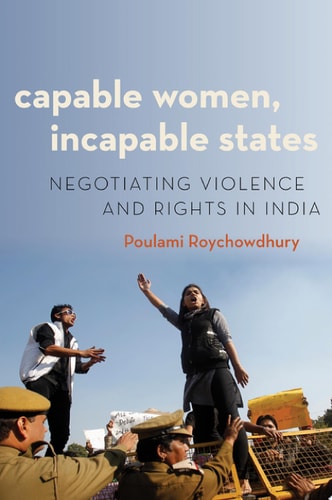
Capable Women, Incapable States: Negotiating Violence and Rights in India
0
0
As an Amazon Associate and affiliate partner, Menrva Books earns from qualifying purchases. Learn more
Author Description
In recent decades, the issue of gender-based violence has become heavily politicized in India. Yet, Indian law enforcement personnel continue to be biased against women and overburdened. In Capable Women, Incapable States, Poulami Roychowdhury asks how women claim rights within these conditions. Through long term ethnography, she provides an in-depth lens on rights negotiations in the world's largest democracy, detailing their social and political effects. Roychowdhury finds that women interact with the law not by following legal procedure or abiding by the rules, but by deploying collective threats and doing the work of the state themselves. And they behave this way because law enforcement personnel do not protect women from harm but do allow women to take the law into their own hands.These negotiations do not enhance legal enforcement. Instead, they create a space where capable women can extract concessions outside the law, all while shouldering a new burden of labor and risk. A unique theory of gender inequality and governance, Capable Women, Incapable States forces us to rethink the effects of rights activism across large parts of the world where political mobilization confronts negligent criminal justice systems.
Menrva's Summary
THE THESIS
How do women navigate and claim rights within a democratic state characterized by biased and overburdened law enforcement? Poulami Roychowdhury, a sociologist specializing in gender and governance, utilizes long-term ethnographic research to examine the disconnect between legal frameworks and the lived reality of women in India. She argues that women bypass formal legal procedures, instead utilizing collective threats and self-help strategies to extract concessions, which ultimately shifts the burden of state labor onto the individuals seeking protection.
THE SCOPE MAP
What You Will Find
- Ethnographic analysis of gender-based violence and rights negotiation in India
- A theoretical framework regarding the intersection of state negligence and individual agency
- Documentation of informal justice mechanisms and collective mobilization
Scope Limits
- The study focuses specifically on the Indian context and may not be directly generalizable to other legal systems
- The research does not provide a comprehensive history of Indian criminal law reform
THE AUTHORITY PERSPECTIVE
Scholars in sociology and South Asian studies identify this work as a significant contribution to the understanding of state-citizen interactions in the Global South. Experts frequently note the clarity of the author's ethnographic methodology and the rigor with which she challenges conventional assumptions about legal rights and state capacity.
Page Count:
252
Publication Date:
2020-01-01
Publisher:
Oxford University Press
ISBN-10:
0190881895
ISBN-13:
9780190881894
Sociology
India
Gender Studies
Human rights
Community Tags
Other Editions(2)
Similar Books