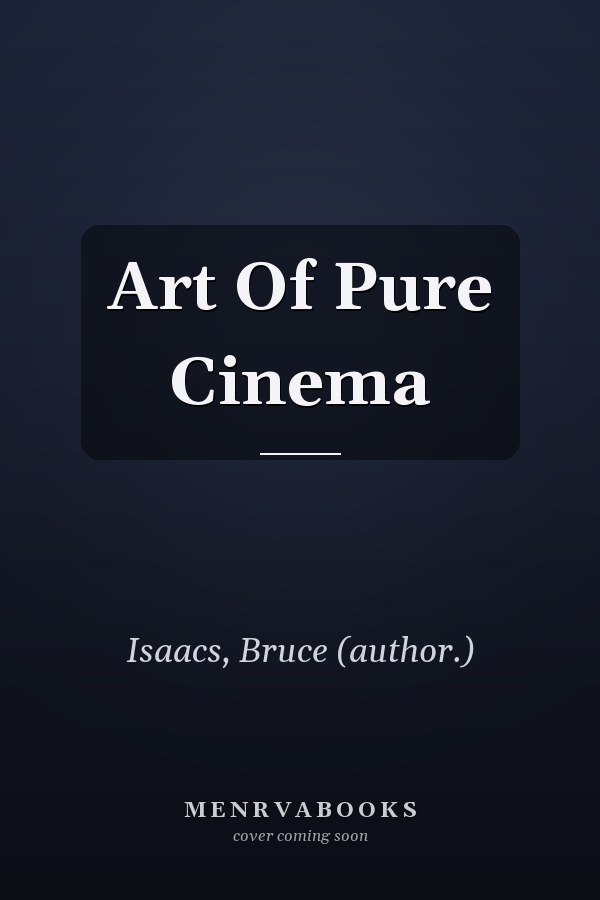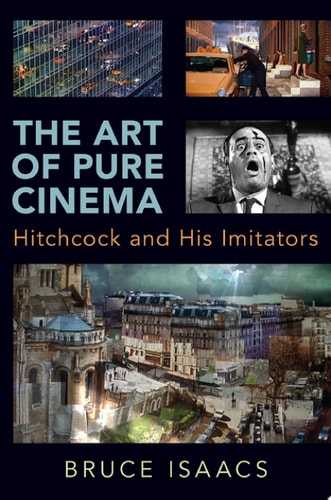
The Art of Pure Cinema: Hitchcock and His Imitators
0
0
As an Amazon Associate and affiliate partner, Menrva Books earns from qualifying purchases. Learn more
Author Description
In a now-famous interview with François Truffaut in 1962, Alfred Hitchcock described his masterpiece Rear Window (1954) as "the purest expression of a cinematic idea." But what, precisely, did Hitchcock mean by pure cinema? Was pure cinema a function of mise en scène, or composition within the frame? Was it a function of montage, "of pieces of film assembled"? This notion of pure cinema has intrigued and perplexed critics, theorists, and filmmakers alike in the decades following this discussion. And even across his 40-year career, Hitchcock's own ideas about pure cinema remained mired in a lack of detail, clarity, and analytical precision.The Art of Pure Cinema is the first book-length study to examine the historical foundations and stylistic mechanics of pure cinema. Author Bruce Isaacs explores the potential of a philosophical and artistic approach most explicitly demonstrated by Hitchcock in his later films, beginning with Hitchcock's contact with the European avant-garde film movement in the mid-1920s. Tracing the evolution of a philosophy of pure cinema across Hitchcock's most experimental works - Rear Window, Vertigo, North by Northwest, Psycho, The Birds, Marnie, and Frenzy - Isaacs rereads these works in a new and vital context. In addition to this historical account, the book presents the first examination of pure cinema as an integrated stylistics of mise en scène, montage, and sound design. The films of so-called Hitchcockian imitators like Mario Bava, Dario Argento, and Brian De Palma are also examined in light of a provocative claim: that the art of pure cinema is only fully realized after Hitchcock.
Menrva's Summary
THE THESIS
This book investigates the precise definition and historical evolution of the concept of 'pure cinema' as articulated by Alfred Hitchcock and interpreted by subsequent filmmakers. Author Bruce Isaacs, a scholar of film studies, utilizes a rigorous analytical framework to deconstruct Hitchcock's later filmography. By examining the intersection of European avant-garde influences and technical execution, Isaacs argues that pure cinema functions as an integrated system of mise en scène, montage, and sound design that reached its full realization in the works of later directors.
THE SCOPE MAP
What You Will Find
- A historical analysis of Hitchcock's engagement with the 1920s European avant-garde movement.
- A technical breakdown of pure cinema as a synthesis of mise en scène, montage, and sound design.
- Comparative studies of Hitchcockian stylistic markers in the films of Mario Bava, Dario Argento, and Brian De Palma.
Scope Limits
- The study focuses primarily on Hitchcock's later career and does not provide an exhaustive analysis of his entire filmography.
- The text prioritizes stylistic and formal mechanics over biographical or psychoanalytic interpretations of the director's life.
THE AUTHORITY PERSPECTIVE
Experts highlight this work as a significant contribution to film theory, noting its success in providing a concrete analytical framework for a previously nebulous concept. Readers frequently observe that the text maintains a high level of academic density, making it most suitable for students and scholars of cinema history.
Page Count:
266
Publication Date:
2020-01-01
Publisher:
Oxford University Press
ISBN-10:
0190889985
ISBN-13:
9780190889982
Influence Literary artistic etc
Film Studies
Alfred Hitchcock
Cinema History
Film Theory
Art Criticism
Community Tags
Similar Books