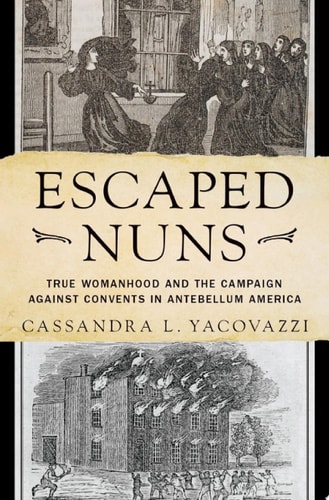
Escaped Nuns: True Womanhood and the Campaign Against Convents in Antebellum America
0
0
As an Amazon Associate and affiliate partner, Menrva Books earns from qualifying purchases. Learn more
Author Description
Just five weeks after its publication in January 1836, Awful Disclosures of the Hotel Dieu Nunnery, billed as an escaped nun's shocking exposé of convent life, had already sold more than 20,000 copies. The book detailed gothic-style horror stories of licentious priests and abusive mothers superior, tortured nuns and novices, and infanticide. By the time the book was revealed to be a fiction and the author, Maria Monk, an imposter, it had already become one of the nineteenth century's best-selling books. In antebellum America only one book, Uncle Tom's Cabin, outsold it.The success of Monk's book was no fluke, but rather a part of a larger phenomenon of anti-Catholic propaganda, riots, and nativist politics. The secrecy of convents stood as an oblique justification for suspicion of Catholics and the campaigns against them, which were intimately connected with cultural concerns regarding reform, religion, immigration, and, in particular, the role of women in the Republic. At a time when the term "female virtue" pervaded popular rhetoric, the image of the veiled nun represented a threat to the established American ideal of womanhood. Unable to marry, she was instead a captive of a foreign foe, a fallen woman, a white slave, and a foolish virgin. In the first half of the nineteenth century, ministers, vigilantes, politicians, and writers--male and female--forged this image of the nun, locking arms against convents. The result was a far-reaching antebellum movement that would shape perceptions of nuns, and women more broadly, in America.
Menrva's Summary
THE THESIS
This book investigates how the fabricated narratives of escaped nuns in antebellum America functioned as a mechanism to define and enforce cultural ideals of womanhood and religious identity. Cassandra L. Yacovazzi, a historian specializing in American religious and gender history, utilizes a wide array of primary sources—including pamphlets, political rhetoric, and popular literature—to argue that anti-convent propaganda was central to the nativist political agenda. She demonstrates that the image of the nun served as a foil to the Protestant American ideal of the domestic, virtuous woman, thereby fueling broader anxieties regarding immigration and religious authority.
THE SCOPE MAP
What You Will Find
- Analysis of the Maria Monk phenomenon and the reception of 'Awful Disclosures of the Hotel Dieu Nunnery'.
- Examination of the intersection between nativist politics and gender ideology in the 19th century.
- Exploration of how anti-Catholic rhetoric utilized the concept of 'female virtue' to mobilize public opinion.
Scope Limits
- The study focuses primarily on the antebellum period and does not extend into late 19th-century or 20th-century anti-Catholic movements.
- The analysis is centered on the American context and does not provide a comprehensive history of European convent life or theology.
THE AUTHORITY PERSPECTIVE
Scholars recognize this work as a significant contribution to the study of American nativism and the construction of gender roles in the 19th century. Readers frequently note the academic rigor and the clarity with which the author connects disparate cultural threads to explain a complex historical phenomenon.
Page Count:
228
Publication Date:
2018-01-01
Publisher:
Oxford University Press
ISBN-10:
019088102X
ISBN-13:
9780190881023
Religion
History
Sociology
Special Topics
American History
United States
Womens Studies
Religious History
Women
Community Tags
Similar Books