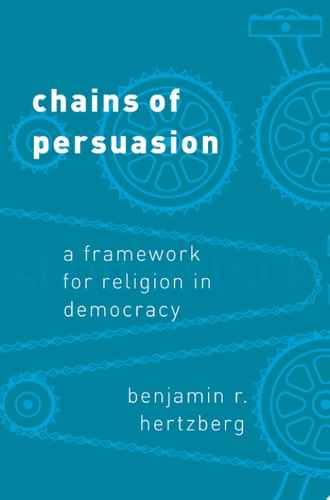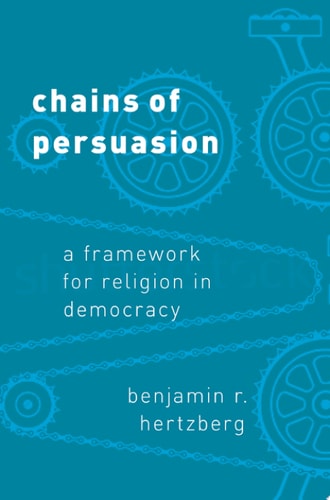
Chains of Persuasion: A Framework for Religion in Democracy
0
0
As an Amazon Associate and affiliate partner, Menrva Books earns from qualifying purchases. Learn more
Author Description
Democratic politics seems to inspire religious conflict - politicians consistently use religious differences for political gain, while religious nationalism and nationalistic reactions to religious diversity are on the rise in much of the world. And yet predominant theoretical accounts of liberal democracy provide citizens precious little applicable guidance in making judgments about religion's proper role in their political societies.Chains of Persuasion provides a new moral framework to guide citizens' evaluations of religious politics. Rejecting claims that religion must be relegated to the private sphere or that all attempts to evaluate its political roles are oppressive, Benjamin Hertzberg argues that democratic ideals are robust enough to assess the full range of ways religion influences democratic political life.Hertzberg's analysis draws on critical theories of religion, philosophical debates about public reason, deliberative and instrumental justifications of democracy, and democratic virtue theory. He argues that citizens must recognize that democracy is a way-of-life, with crucial implications for civic society beyond formal political institutions, in order to attend to the ways in which religion can both enhance and undermine democracy.He applies this framework by criticizing American public discussions of two prominent religious minorities: Mormons and Muslims. If citizens are to make judgments consistent with democratic norms, they must pay more attention to the nature of religions' authority claims instead of merely evaluating the values religions proclaim.
Menrva's Summary
THE THESIS
How can citizens effectively evaluate the role of religion in democratic societies without resorting to exclusionary or oppressive rhetoric? Benjamin R. Hertzberg, a scholar of political theory, constructs a moral framework that moves beyond the binary of public versus private religion. By synthesizing critical theories of religion with democratic virtue theory, he argues that democracy functions as a way-of-life that requires citizens to scrutinize the authority claims of religious groups rather than focusing solely on their stated values.
THE SCOPE MAP
What You Will Find
- A theoretical framework for assessing religious influence in civic society.
- An analysis of democratic virtue theory and public reason.
- Critical examinations of American discourse regarding Mormon and Muslim minorities.
Scope Limits
- The text does not provide a comprehensive history of global religious movements.
- It does not offer a prescriptive policy manual for legislative action.
THE AUTHORITY PERSPECTIVE
Scholars and political theorists frequently note the academic density of the prose and the rigor of Hertzberg's philosophical synthesis. Experts highlight this as a significant contribution to the ongoing debate regarding the intersection of secular democratic norms and religious identity.
Page Count:
224
Publication Date:
2018-12-26
Publisher:
Oxford University Press
ISBN-10:
0190883049
ISBN-13:
9780190883041
Philosophy
Sociology of Religion
Freedom of religion
Religion and Politics
Decision Making
Religious Aspects
Democratic Theory
Community Tags
Similar Books