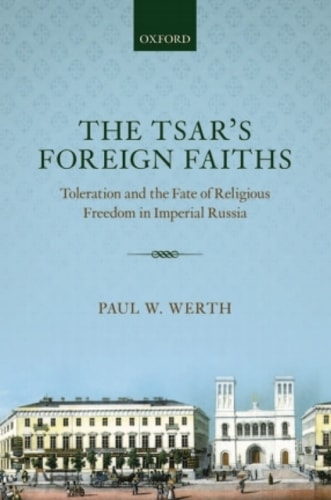
The Tsar's Foreign Faiths: Toleration and the Fate of Religious Freedom in Imperial Russia
0
0
As an Amazon Associate and affiliate partner, Menrva Books earns from qualifying purchases. Learn more
Author Description
The Russian Empire presented itself to its subjects and the world as an Orthodox state, a patron and defender of Eastern Christianity. Yet the tsarist regime also lauded itself for granting religious freedoms to its many heterodox subjects, making 'religious toleration' a core attribute of the state's identity. The Tsar's Foreign Faiths shows that the resulting tensions between the autocracy's commitments to Orthodoxy and its claims to toleration became a defining feature of the empire's religious order. In this panoramic account, Paul W. Werth explores the scope and character of religious freedom for Russia's diverse non-Orthodox religions, from Lutheranism and Catholicism to Islam and Buddhism. Considering both rhetoric and practice, he examines discourses of religious toleration and the role of confessional institutions in the empire's governance. He reveals the paradoxical status of Russia's heterodox faiths as both established and 'foreign', and explains the dynamics that shaped the fate of newer conceptions of religious liberty after the mid-nineteenth century. If intellectual change and the shifting character of religious life in Russia gradually pushed the regime towards the acceptance of freedom of conscience, then statesmen's nationalist sentiments and their fears of 'politicized' religion impeded this development. Russia's religious order thus remained beset by contradiction on the eve of the Great War. Based on archival research in five countries and a vast scholarly literature, The Tsar's Foreign Faiths represents a major contribution to the history of empire and religion in Russia, and to the study of toleration and religious diversity in Europe.
Menrva's Summary
THE THESIS
This book investigates the inherent contradictions between the Russian Empire's self-identification as an Orthodox state and its stated commitment to religious toleration for its diverse subjects. Paul W. Werth, a specialist in the history of the Russian Empire, utilizes extensive archival research across five countries to analyze how the state managed non-Orthodox faiths. He argues that the tension between imperial governance, nationalist sentiment, and the evolving concept of freedom of conscience created a volatile religious order that persisted until the onset of the Great War.
THE SCOPE MAP
What You Will Find
- Analysis of the legal and social status of Lutheranism, Catholicism, Islam, and Buddhism within the Russian Empire.
- Examination of the shift in religious policy from the mid-nineteenth century through the early twentieth century.
- Evaluation of the interplay between state rhetoric regarding toleration and the practical application of governance over confessional institutions.
Scope Limits
- The study focuses primarily on the institutional and political dimensions of religious policy rather than the internal theological developments of the faiths themselves.
- The narrative concludes at the eve of the Great War and does not extend into the Soviet era.
THE AUTHORITY PERSPECTIVE
Scholars recognize this work as a definitive analysis of the complexities surrounding religious pluralism in the Russian imperial context. Readers frequently note the academic density of the prose and the depth of the archival evidence provided to support the author's arguments.
Page Count:
304
Publication Date:
2014-01-01
Publisher:
OUP Oxford
ISBN-10:
0191667625
ISBN-13:
9780191667626
History
Sociology of Religion
European History
Church & State
Political History
Religious History
Freedom of religion
Russian History
Church History
Community Tags
Similar Books