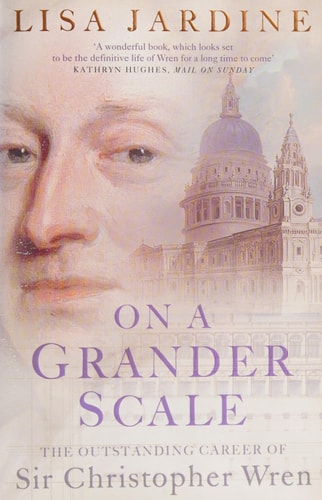
On a Grander Scale: The Outstanding Career of Sir Christopher Wren
0
0
As an Amazon Associate and affiliate partner, Menrva Books earns from qualifying purchases. Learn more
Author Description
A biography of Sir Christopher Wren from one of Britains best writers and historiansThe figure of Sir Christopher Wren looms large in English national consciousness. The imposing beauty of St Paul's Cathedral stands forever for the nation's achievement its undamaged dome towering above the rubble of the Blitz in the Second World War a symbol of the London's indomitable fighting spirit.The man behind the work was as remarkable as the monuments he has left us. Lisa Jardine takes us deep into Wren's imagination and discovers the unique, exacting nature of his mind and the emerging new world of late-seventeenth-century science and ideas.Wren was a versatile genius who could have pursued a number of brilliant careers with equal virtuosity. A mathematical prodigy, an accomplished astronomer, a skilful anatomist, and a founder of The Royal Society, he eventually made a career in what he described in later life as 'Rubbish' architecture, and the design and construction of public buildings. But he remained committed to science. The Monument to the Great Fire was built with a subterranean laboratory; the south-west tower of St Paul's was used as a vertical telescope during construction both were designed to function as public monuments and as oversized scientific instruments.Wren was a major figure at a turning point in English history. He mapped moons and the trajectories of comets for kings; lived and worked under six monarchs; pursued astronomy and medicine through two civil wars, the English Commonwealth, the Great Fire, the Restoration, and the eventual extinction of the Stuart dynasty.Jardine explores also Wren's personal motivations and passions. A sincere man with a remarkable capacity for friendship, his career was shaped by lasting associations forged during a turbulent boyhood, and a lifelong loyalty to the memory of his father's master and benefactor, the 'martyred' king, Charles I
Menrva's Summary
THE THESIS
This biography investigates how Sir Christopher Wren’s multifaceted genius as a scientist and mathematician fundamentally shaped his approach to architecture during a period of profound political and intellectual transition in England. Lisa Jardine, a renowned historian, utilizes primary source documents and historical context to argue that Wren’s architectural masterpieces were not merely aesthetic achievements but were deeply integrated with his scientific pursuits. The narrative examines how Wren navigated the volatile political landscape under six monarchs while maintaining his commitment to the Royal Society and the advancement of empirical knowledge.
THE SCOPE MAP
What You Will Find
- Detailed examination of Wren's contributions to astronomy, mathematics, and anatomy.
- Analysis of the intersection between 17th-century scientific experimentation and public monument design.
- Historical context regarding the English Civil War, the Great Fire of London, and the Restoration.
- Insights into Wren's personal relationships and his enduring loyalty to the Stuart monarchy.
THE AUTHORITY PERSPECTIVE
This work is regarded as a comprehensive and scholarly exploration of Wren’s life, praised for its ability to synthesize his scientific and architectural achievements within the broader context of seventeenth-century intellectual history. The text provides a dense, well-researched account that will appeal to readers interested in the history of science and the evolution of English architecture.
Page Count:
416
Publication Date:
2003-01-01
Publisher:
HarperCollins Publishers Ltd
ISBN-10:
0007107765
ISBN-13:
9780007107766
Biography
Architecture
History
17th Century
Science History
British History
Architects
Community Tags
Similar Books