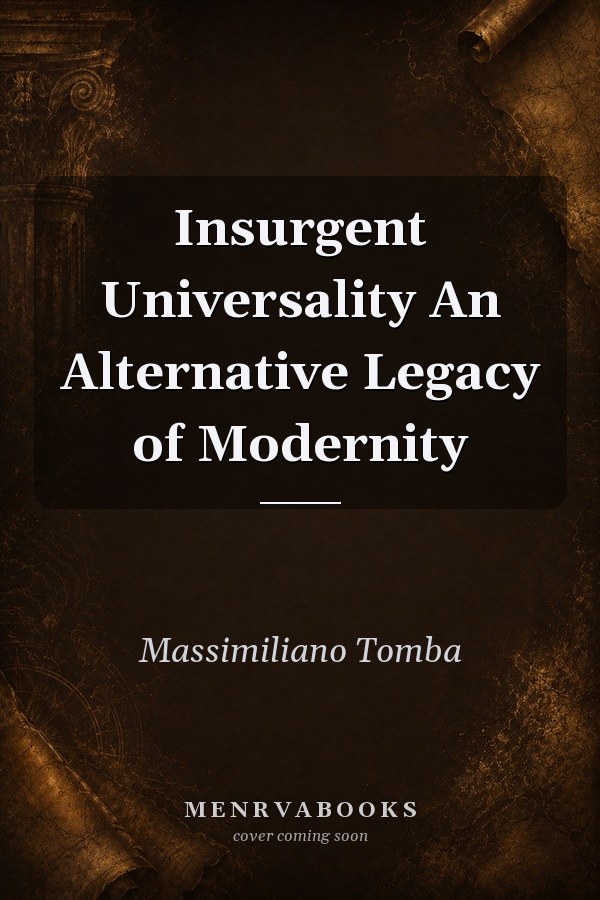
Insurgent Universality An Alternative Legacy of Modernity
0
0
As an Amazon Associate and affiliate partner, Menrva Books earns from qualifying purchases. Learn more
Author Description
Scholars commonly take the French Declaration of the Rights of Man and Citizen of 1789, written during the French Revolution, as the starting point for modern concepts of human rights. According to the declaration, the rights of man are held to be universal, at all times and all places. But as recent crises around migrants and refugees have made obvious, this idea, sacred as it might be among human rights advocates, isn't credible. It's long past time to reconsider the principles on which Western economic and political norms rest. We can look to recent history to see various experiments in cooperative democracy: the Indignados in Spain, the Arab Spring, Occupy, the Zapatistas in Mexico. Some of these movements fade almost as soon as they emerge, perhaps in part because they struggle to find a common legacy. This book argues that these movements do have a common tradition, but that to find it we need to abandon the idea of a universal history. In Europe and elsewhere, since the late eighteenth century, there have been numerous movements or "roads not taken"--The Paris Commune, the 1917 peasant revolts during the Russian Revolution, the Haitian Revolution -- that were disrupted. Tomba wants to "reactivate" the legacies of these movements to show what could have been and what can still be. He suggests that we need to think of history as having multiple dimensions that coexist and conflict with one another. The roads not taken show an alternative idea of universality. This is a universalism that isn't based on the idea that we all share some common humanity, but on the opportunity for people to disrupt and reject the existing political and economic order
Menrva's Summary
THE THESIS
Massimiliano Tomba investigates whether the conventional, singular narrative of modern human rights, rooted in the 1789 French Declaration, can be replaced by an alternative, pluralistic model of universality. Tomba, a professor of history of consciousness, utilizes a critical historical framework to challenge the hegemony of Western liberal norms. He argues that by examining suppressed historical movements—the 'roads not taken'—we can identify a different, insurgent form of universality that prioritizes the capacity of people to disrupt and reject oppressive political and economic structures.
THE SCOPE MAP
What You Will Find
- Analysis of historical movements including the Paris Commune, the Haitian Revolution, and the 1917 Russian peasant revolts.
- A critique of the 1789 French Declaration of the Rights of Man and Citizen.
- Theoretical exploration of 'insurgent universality' as a rejection of monolithic historical progress.
- Connections between historical disruptions and contemporary movements like the Arab Spring and Occupy.
Scope Limits
- The text does not provide a comprehensive history of all global revolutionary movements.
- It does not offer a prescriptive policy manual for modern governance.
THE AUTHORITY PERSPECTIVE
Scholars and political theorists frequently note the dense, philosophical nature of Tomba's prose, which requires familiarity with critical theory. Experts highlight this work as a significant contribution to the ongoing debate regarding the limitations of traditional human rights discourse.
Page Count:
286
Publication Date:
2019-01-01
Publisher:
Oxford University Press
ISBN-10:
0190883111
ISBN-13:
9780190883119
History
Philosophy
Human rights
Political Theory
Community Tags
Similar Books