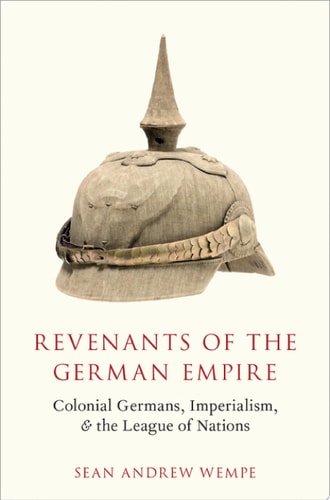
Revenants of the German Empire: Colonial Germans, Imperialism, and the League of Nations
0
0
As an Amazon Associate and affiliate partner, Menrva Books earns from qualifying purchases. Learn more
Author Description
In 1919 the Treaty of Versailles stripped Germany of its overseas colonies. This sudden transition to a post-colonial nation left the men and women invested in German imperialism to rebuild their status on the international stage. Remnants of an earlier era, these Kolonialdeutsche (Colonial Germans) exploited any opportunities they could to recover, renovate, and market their understandings of German and European colonial aims in order to reestablish themselves as "experts" and "fellow civilizers" in discourses on nationalism and imperialism. Revenants of the German Empire: Colonial Germans, Imperialism, and the League of Nations tracks the difficulties this diverse group of Colonial Germans encountered while they adjusted to their new circumstances, as repatriates to Weimar Germany or as subjects of the War's victors in the new African Mandates. Faced with novel systems of international law, Colonial Germans re-situated their notions of imperial power and group identity to fit in a world of colonial empires that were not their own. The book examines how former colonial officials, settlers, and colonial lobbies made use of the League of Nations framework to influence diplomatic flashpoints including the Naturalization Controversy in Southwest Africa, the Locarno Conference, and the Permanent Mandates Commission from 1927-1933. Sean Wempe revises standard historical portrayals of the League of Nations' form of international governance, German participation in the League, the role of interest groups in international organizations and diplomacy, and liberal imperialism. In analyzing Colonial German investment and participation in interwar liberal internationalism, the project challenges the idea of a direct continuity between Germany's colonial period and the Nazi era.
Menrva's Summary
THE THESIS
This book investigates how former German colonial actors navigated the transition from an imperial power to a post-colonial state by leveraging the League of Nations framework. Sean Andrew Wempe, a historian specializing in modern European history, utilizes archival research and diplomatic records to argue that these individuals actively reshaped their identities as international experts. By participating in interwar liberal internationalism, these actors sought to maintain their status and influence within a global system that had officially stripped them of their colonies.
THE SCOPE MAP
What You Will Find
- Analysis of the Naturalization Controversy in Southwest Africa and the Locarno Conference.
- Examination of the Permanent Mandates Commission from 1927 to 1933.
- Investigation into the activities of colonial lobbies, former officials, and settlers.
Scope Limits
- The study focuses primarily on the interwar period and does not provide an exhaustive history of the entire German colonial era.
- The text does not center on the domestic political developments of the Nazi party, focusing instead on international diplomatic frameworks.
THE AUTHORITY PERSPECTIVE
Historians recognize this work as a significant contribution to the study of interwar diplomacy and the evolution of liberal imperialism. Scholars frequently note the author's ability to challenge traditional narratives regarding the continuity between German colonial history and the rise of the Third Reich.
Page Count:
302
Publication Date:
2019-01-01
Publisher:
Oxford University Press
ISBN-10:
0190907231
ISBN-13:
9780190907235
History
German history
Military History
Politics & Government
Decolonization
European History
International relations
Germans_africa
Colonialism
Diplomatic History
Community Tags
Similar Books