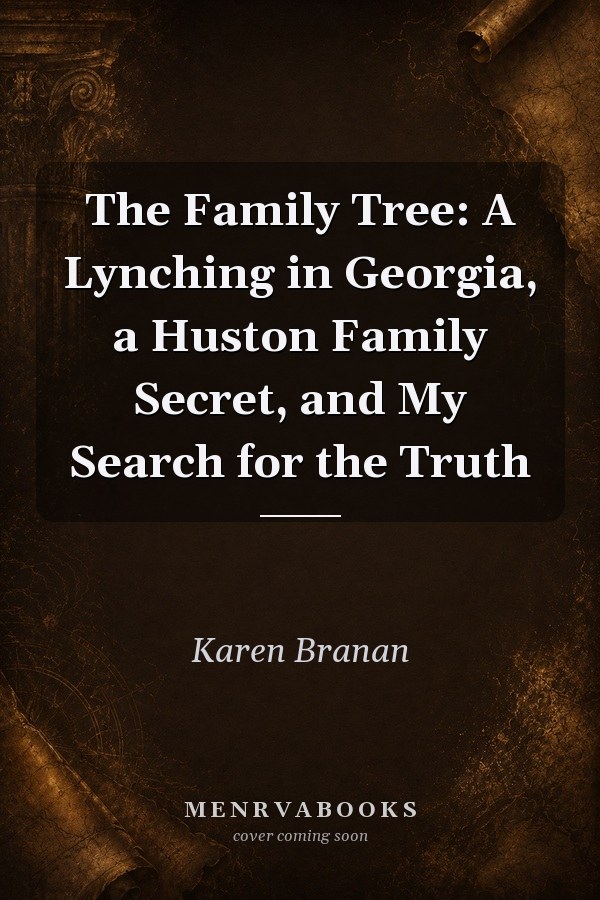
The Family Tree: A Lynching in Georgia, a Huston Family Secret, and My Search for the Truth
0
0
As an Amazon Associate and affiliate partner, Menrva Books earns from qualifying purchases. Learn more
Author Description
In the tradition of Slaves in the Family, the provocative true account of the hanging of four black people by a white lynch mob in 1912--written by the great-granddaughter of the sheriff charged with protecting them. Harris County, Georgia, 1912. A white man, the beloved nephew of the county sheriff, is shot dead on the porch of a black woman. Days later, the sheriff sanctions the lynching of a black woman and three black men; all of them innocent. For Karen Branan, the great-granddaughter of that sheriff, this isn't just history, this is family history. Branan spent nearly twenty years combing through diaries and letters, hunting for clues in libraries and archives throughout the United States, and interviewing community elders to piece together the events and motives that led a group of people to murder four of their fellow citizens in such a brutal public display. Her research revealed surprising new insights into the day-to-day reality of race relations in the Jim Crow-era South, but what she ultimately discovered was far more personal. As she dug into the past, Branan was forced to confront her own deep-rooted beliefs surrounding race and family, a process that came to a head when Branan learned a shocking truth: she is related not only to the sheriff, but also to one of the four who were murdered. Both identities--perpetrator and victim--are her inheritance to bear. A gripping story of privilege and power, anger, and atonement, The Family Tree transports readers to a small Southern town steeped in racial tension and bound by powerful family ties. Branan takes us back in time to the Civil War, demonstrating how plantation politics and the Lost Cause movement set the stage for the fiery racial dynamics of the twentieth century, delving into the prevalence of mob rule, the rise of the Ku Klux Klan and the role of miscegenation in an unceasing cycle of bigotry. Through all of this, what emerges is a searing examination of the violence that occurred on that awful
Menrva's Summary
THE THESIS
How did the intersection of personal lineage and systemic racial violence in the Jim Crow-era South shape the legacy of a 1912 lynching in Harris County, Georgia? Karen Branan, a journalist and descendant of the sheriff who sanctioned the murders, utilizes two decades of archival research, personal correspondence, and oral histories to reconstruct the events surrounding the death of four innocent individuals. Her investigation serves as both a historical account of mob rule and a personal reckoning with the dual inheritance of perpetrator and victim ancestry. By tracing the roots of the incident back to the Civil War and the Lost Cause movement, Branan argues that the violence was not an isolated anomaly but a predictable outcome of entrenched plantation politics and racial hierarchy.
THE SCOPE MAP
What You Will Find
- A detailed reconstruction of the 1912 Harris County lynching and its immediate aftermath.
- An analysis of the socio-political climate in the American South, including the rise of the Ku Klux Klan and the prevalence of mob rule.
- Primary source research utilizing family diaries, letters, and interviews with community elders.
- A critical examination of how miscegenation and family secrets influenced the racial dynamics of the twentieth century.
THE AUTHORITY PERSPECTIVE
This work provides a rigorous and deeply personal examination of historical trauma, blending investigative journalism with genealogical discovery. The text offers a dense, scholarly look at the mechanisms of racial violence while maintaining a focus on the author's individual process of confronting her family's complicity.
Page Count:
0
Publication Date:
2016-02-09
Publisher:
Fourth Estate
ISBN-10:
0007162146
ISBN-13:
9780007162147
History
Biography
True Crime
Family Saga
Southern History
Genre Fiction
United States
African American
Race Relations
Literature & Fiction
Social Science
Community Tags
Similar Books