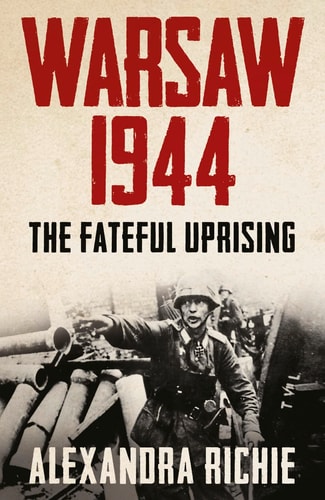
Warsaw 1944: The Fateful Uprising
0
0
As an Amazon Associate and affiliate partner, Menrva Books earns from qualifying purchases. Learn more
Author Description
The traumatic story of one of the last major battles of World War II, in which the Poles fought off German troops and police, street by street, for sixty-three days. The Warsaw Uprising of August 1944 was a shocking event in a hideous war. This is the first account to recall the tragedy from both German and Polish perspectives and asks why, when the war was nearly lost and resources were so urgently needed in the Fatherland, Hitler and Himmler decided to return to Warsaw bent on murder, deportation, and destruction. This was the only time in history that a European capital has ever been emptied of its entire population and destroyed street by street, house by house, razed leaving acres of smouldering ruin. Hundreds were thrown from windows, burned alive, trampled to death. The murder of 40,000 innocents on 5th August was the largest battlefield massacre of the war. But the Poles did not give in. Organized and popular, the Uprising, which had been expected to last under a week, fought off German troops including Himmler's most notorious SS battalions street by street, for sixty-three days. Alexandra Richie is connected to this story through her father-in-law Wladyslaw Bartoszewski who participated in the Uprising and whose vast archive forms the basis of the book, The book charts Nazi crimes but also through the testimony of a Pole press-ganged into a 'cremation detail' who, by living amongst them witnessed the break-down of morale in the SS at the end of the war. Dr Richie puts the Uprising in context of the collapse of Army Group Centre and the now forgotten battles which raged around Warsaw in the summer of 1944. She looks at the implications of Stalin's refusal to help the beleaguered Poles and shows for the first time how the Nazi leadership, and Himmler in particular, hoped that the increasing divisions between the Allies over Warsaw would lead to a Third World War. She also shows how the Uprising affected negotiations over the fate of post- war Europe and is r
Menrva's Summary
THE THESIS
This work investigates the strategic, political, and human dimensions of the 1944 Warsaw Uprising, questioning why the Nazi leadership prioritized the total destruction of the city despite the imminent collapse of their war effort. Dr. Alexandra Richie utilizes an extensive archive, including personal testimonies from participants like Wladyslaw Bartoszewski, to reconstruct the sixty-three-day conflict. The book argues that the Uprising was not merely a local battle but a pivotal event that exposed deep fractures within the Allied coalition and influenced the geopolitical landscape of post-war Europe.
THE SCOPE MAP
What You Will Find
- Comprehensive analysis of the military collapse of Army Group Centre during the summer of 1944.
- Dual-perspective examination of the conflict, incorporating both Polish resistance accounts and German military records.
- Detailed documentation of Nazi war crimes, including the systematic destruction of Warsaw and the massacre of civilians.
- Investigation into the political motivations of Stalin and the Nazi leadership regarding the fate of the Polish capital.
THE AUTHORITY PERSPECTIVE
This text provides a rigorous, scholarly examination of the Warsaw Uprising, distinguished by its access to rare archival materials and its balanced integration of opposing viewpoints. The depth of research and the inclusion of previously overlooked military context make it a significant contribution to the historiography of the Second World War.
Page Count:
738
Publication Date:
2013-10-01
Publisher:
William Collins
ISBN-10:
0007180411
ISBN-13:
9780007180417
History
Military
Subjects
Poland
World War
European History
Military History
Europe
Community Tags
Similar Books