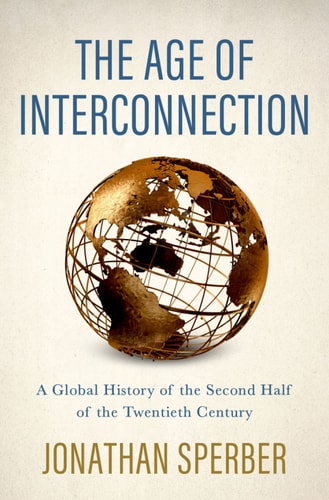
The Age of Interconnection: A Global History of the Second Half of the Twentieth Century
0
0
As an Amazon Associate and affiliate partner, Menrva Books earns from qualifying purchases. Learn more
Author Description
A panoramic view of global history from the end of World War Two to the dawn of the new millennium, and a portrait of an age of unprecedented transformation.In this ambitious, groundbreaking, and sweeping work, Jonathan Sperber guides readers through six decades of global history, from the end of World War Two to the onset of the new millennium. As Sperber's immersive and propulsive book reveals, the defining quality of these decades involved the rising and unstoppable flow of people, goods, capital, and ideas across boundaries, continents, and oceans, creating prosperity in some parts of the world, destitution in others, increasing a sense of collective responsibility while also reinforcing nationalism and xenophobia. It was an age of transformation in every realm of human existence: from relations with nature to relations between and among nations, superpowers to emerging states; from the forms of production to the foundations of religious faith. These changes took place on an unprecedentedly global scale. The world both developed and contracted. Most of all, it became interconnected.To make sense of it, Sperber illuminates the central trends and crucial developments across a wide variety of topics, adopting a chronology that divides the era into three distinct periods: the postwar, from 1945 through 1966, which retained many elements of period of world wars; the upheaval of the 1960s and 1970s, when the pillars of the postwar world were undermined; and the two decades at the end of the millennium, when new structures were developed, structures that form the basis of today's world, even as the iconic World Trade Center was reduced by terrorism to rubble. The Age of Interconnection is a clear-eyed portrait of an age of blinding change.
Menrva's Summary
THE THESIS
This work investigates the defining characteristics of global transformation between 1945 and 2000, specifically focusing on the mechanisms of increasing international integration. Jonathan Sperber, a historian specializing in modern European history, utilizes a comparative framework to analyze how the movement of capital, people, and ideas reshaped global power structures. He argues that the second half of the twentieth century was defined by a paradox where the world simultaneously contracted through connectivity and expanded through disparate economic outcomes.
THE SCOPE MAP
What You Will Find
- A tripartite chronological framework: 1945-1966, the 1960s-1970s, and 1980-2000.
- Analysis of shifts in production, religious belief, and environmental relations.
- Examination of the transition from postwar stability to the emergence of modern globalized structures.
Scope Limits
- The text does not provide an exhaustive day-by-day chronicle of every nation-state.
- It focuses primarily on macro-level trends rather than micro-biographies of individual political figures.
THE AUTHORITY PERSPECTIVE
Scholars and reviewers frequently note the breadth of Sperber's synthesis, which successfully manages a vast array of global data points within a coherent narrative. Experts highlight this as a useful text for understanding the structural foundations of the contemporary international order.
Page Count:
809
Publication Date:
2022-01-01
Publisher:
Oxford University Press
ISBN-10:
0190918977
ISBN-13:
9780190918972
Economics
History
Special Topics
Modern History
Sociology
20th Century
Global History
Community Tags
Similar Books