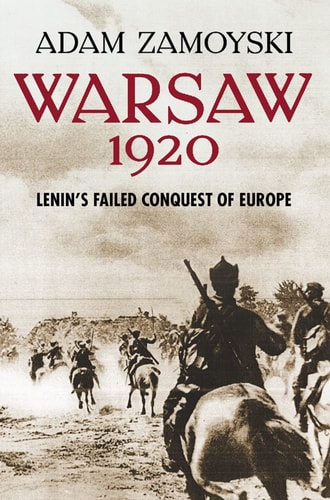
Warsaw 1920: Lenin’s Failed Conquest of Europe
0
0
As an Amazon Associate and affiliate partner, Menrva Books earns from qualifying purchases. Learn more
Author Description
The dramatic and little-known story of how, in the summer of 1920, Lenin came within a hair's breadth of shattering the painstakingly constructed Versailles peace settlement and spreading Bolshevism to western Europe.In 1920 the new Soviet state was a mess, following a brutal civil war, and the best way of ensuring its survival appeared to be to export the revolution to Germany, itself economically ruined by defeat in World War I and racked by internal political dissension.Between Russia and Germany lay Poland, a nation that had only just recovered its independence after more than a century of foreign oppression. But it was economically and militarily weak and its misguided offensive to liberate the Ukraine in the spring of 1920 laid it open to attack. Egged on by Trotsky, Lenin launched a massive westward advance under the flamboyant Marshal Tukhachevsky.All that Great Britain and France had fought for over four years now seemed at risk. By the middle of August the Russians were only a few kilometres from Warsaw, and Berlin was less than a week's march away. Then occurred the 'Miracle of the Vistula': the Polish army led by Jozef Pilsudski regrouped and achieved one of the most decisive victories in military history.As a result, the Versailles peace settlement survived, and Lenin was forced to settle for Communism in one country. The battle for Warsaw bought Europe nearly two decades of peace, and communism remained a mainly Russian phenomenon, subsuming many of the autocratic and Byzantine characteristics of Russia's tsarist tradition.
Menrva's Summary
THE THESIS
This work investigates how the Polish-Soviet War of 1920 served as a critical pivot point that prevented the spread of Bolshevism into Western Europe and preserved the post-World War I international order. Adam Zamoyski, a historian specializing in Polish and European history, utilizes a synthesis of diplomatic records and military accounts to reconstruct the strategic landscape of 1920. He argues that the survival of the nascent Soviet state depended on exporting revolution to a destabilized Germany, with Poland acting as the primary obstacle and battleground in this geopolitical struggle.
THE SCOPE MAP
What You Will Find
- Detailed analysis of the geopolitical tensions between the Soviet Union, Poland, and the post-Versailles European powers.
- Examination of the military strategies employed by Marshal Tukhachevsky and Jozef Pilsudski.
- Primary source insights into the decision-making processes of Lenin and Trotsky regarding the export of revolution.
- A comprehensive account of the Battle of Warsaw, often referred to as the Miracle of the Vistula.
THE AUTHORITY PERSPECTIVE
The text provides a rigorous and accessible examination of a pivotal yet frequently overlooked conflict in 20th-century history. Its focus on the strategic implications of the Polish victory offers a clear understanding of how this specific campaign shaped the subsequent geopolitical trajectory of the European continent.
Page Count:
224
Publication Date:
2008-02-04
Publisher:
HarperPress
ISBN-10:
0007225520
ISBN-13:
9780007225521
History
Warsaw poland history
European History
Military History
Poland
Soviet Union
Community Tags
Similar Books