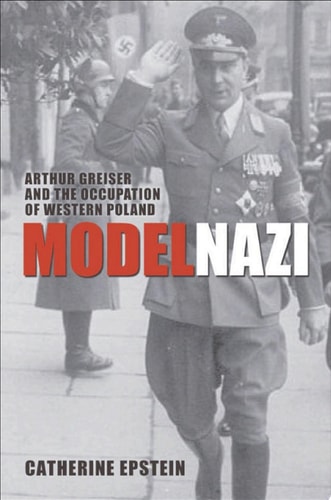
Model Nazi: Arthur Greiser and the Occupation of Western Poland
0
0
As an Amazon Associate and affiliate partner, Menrva Books earns from qualifying purchases. Learn more
Author Description
Model Nazi tells the story of Arthur Greiser, the man who initiated the Final Solution in Nazi-occupied Poland. Between 1939 and 1945, Greiser was the territorial leader of the Warthegau, an area of western Poland annexed to Nazi Germany. In an effort to make the Warthegau 'German,' Greiser introduced numerous cruel policies. He spearheaded an influx of hundreds of thousands of ethnic Germans. He segregated Germans from Poles, and introduced wide-ranging discriminatory measures against the Polish population. He refashioned the urban and natural landscape to make it 'German.' And even more chillingly, the first and longest standing ghetto, the largest forced labour program, and the first mass gassings of Jews in Nazi-occupied Europe were all initiated under Greiser's jurisdiction. Who was the man behind these dreadful policies? Catherine Epstein gives us a compelling biographical portrait of Greiser the man: his birth in the German-Polish borderlands, his rise to Nazi prominence in Danzig, his actions as party leader in the Warthegau, and his trial and execution in postwar Poland. Drawing on a remarkable array of German and Polish sources, she shows how nationalist obsessions, political jealousies, and personal insecurities shaped the policies of a man who held remarkable power in his Nazi fiefdom. Throughout, Epstein confronts a burning question of our age: why do individuals imagine genocide and ethnic cleansing to be solutions to political problems?
Menrva's Summary
THE THESIS
This biography investigates the motivations and administrative actions of Arthur Greiser to understand how an individual facilitates the implementation of genocide and ethnic cleansing within a political framework. Catherine Epstein, a historian specializing in modern European history, utilizes a comprehensive range of German and Polish archival sources to reconstruct Greiser's life. The work examines his trajectory from his origins in the borderlands to his role as the Gauleiter of the Warthegau, arguing that personal insecurities and nationalist fervor were central to his radicalization and subsequent policies.
THE SCOPE MAP
What You Will Find
- Detailed analysis of the administrative policies implemented in the Warthegau between 1939 and 1945.
- Examination of the early stages of the Final Solution, including the first mass gassings and forced labor programs.
- Biographical data regarding Greiser's rise within the Nazi party in Danzig.
- Primary source documentation from both German and Polish archives.
Scope Limits
- The text focuses specifically on Greiser's jurisdiction and does not provide a comprehensive history of the entire Nazi occupation of Poland.
- It does not attempt to provide a psychological profile beyond the evidence found in his political actions and public record.
THE AUTHORITY PERSPECTIVE
Experts recognize this work as a significant contribution to the study of Nazi regional administration and the mechanics of the Holocaust. Readers frequently note the academic rigor of the research and the clarity with which Epstein connects individual actions to broader systemic atrocities.
Page Count:
468
Publication Date:
2010-01-01
Publisher:
OUP Oxford
ISBN-10:
0191613843
ISBN-13:
9780191613845
History
Biography
Poland biography
Social Conditions
European History
Poland
Military History
World War
Ethnic relations