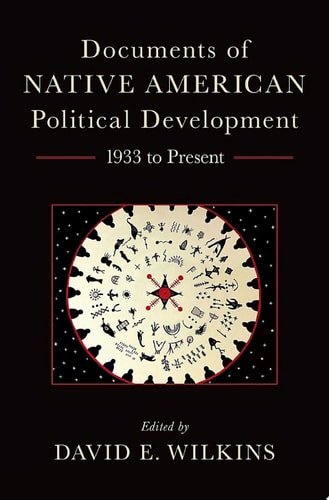
Documents of Native American Political Development: 1933 to Present
0
0
As an Amazon Associate and affiliate partner, Menrva Books earns from qualifying purchases. Learn more
Author Description
Before Europeans arrived in what is now known as the United States, over 600 diverse Native nations lived on the same land. This encroachment and subsequent settlement by Americans forcibly disrupted the lives of all indigenous peoples and brought about staggering depopulation, loss of land, and cultural, religious, and economic changes. These developments also wrought profound changes in indigenous politics and longstanding governing institutions. David E. Wilkins' two-volume work Documents of Native American Political Development traces how indigenous peoples have maintained and continued to exercise a significant measure of self-determination contrary to presumptions that such powers had been lost, surrendered, or vanquished. Volume One provided materials from the 1500s to 1933. This collection of primary source and other documents begins in 1933 and spans the subsequent eight decades. Broadly, the volume organizes this period into the following distinctive eras: indigenous political resurgence and reorganization (1934 to 1940s); indigenous termination/relocation (1940s to 1960s); indigenous self-determination (1960s to 1980s); and indigenous self-governance (1980s to present). Wilkins presents documents including the governing arrangements Native nations created and adapted that are comparable to formal constitutions; international and interest group records; statements by prominent Native and non-Native individuals; and sources featuring important innovations that display the political acumen of Native nations. The documents are arranged chronologically, and Wilkins provides concise, introductory essays to each document, placing them within the proper context. Each introduction is followed by a brief list of suggestions for further reading.This continued examination of fascinating and relatively unknown indigenous history, from a number of influential legal and political writings to the formal constitutions crafted since the American intervention of the Indian
Menrva's Summary
THE THESIS
This volume investigates the evolution of indigenous political development and self-determination within the United States from 1933 to the present. David E. Wilkins, a scholar of Native American politics and law, utilizes a curated collection of primary source documents to demonstrate how indigenous nations have maintained and adapted their governing institutions despite external pressures. The work provides a structured framework for understanding the resilience of Native political systems through four distinct historical eras of federal policy and tribal response.
THE SCOPE MAP
What You Will Find
- Primary source documents including tribal constitutions, international records, and interest group statements.
- Chronological organization covering political resurgence, termination and relocation, self-determination, and self-governance.
- Introductory essays for each document providing historical and legal context.
- Bibliographic suggestions for further reading following each entry.
Scope Limits
- This volume specifically focuses on the period from 1933 to the present and does not cover the era prior to 1933.
- The collection emphasizes formal political and legal documentation rather than oral histories or cultural narratives.
THE AUTHORITY PERSPECTIVE
Scholars and students of indigenous law frequently cite this work as a vital reference for understanding the legal mechanisms of tribal sovereignty. Experts highlight the text for its meticulous organization and its ability to provide clear context for complex legislative and political developments.
Page Count:
538
Publication Date:
2018-01-01
Publisher:
Oxford University Press
ISBN-10:
019091839X
ISBN-13:
9780190918392
History
Government
Professional Career & Trade
History of the Americas
Native American
Law
Community Tags
Other Editions(2)
Similar Books








Reader Comments
Share Your Thoughts
No comments yet. Be the first to share your thoughts!