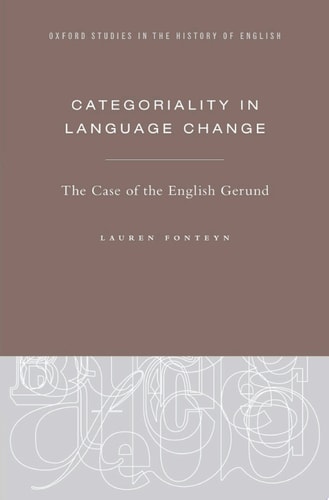
Categoriality in Language Change: The Case of the English Gerund
0
0
As an Amazon Associate and affiliate partner, Menrva Books earns from qualifying purchases. Learn more
Author Description
This book presents the first serious attempt to set out a functional-semantic definition of diachronic transcategorial shift between the major classes noun/nominal and verb/clause. In English, speakers have different options to refer to an event, ranging from that-clauses (That he had guessed her size) over infinitives (For him to guess her size) and verbal gerunds (Him guessing her size) to nominal gerunds (His guessing of her size) and deverbal nouns (His guess of her size). Interestingly, not only do these strategies each resemble "prototypical" nominals to varying extents, but also some of these strategies increasingly resemble clauses and decreasingly resemble prototypical nominals over time, as if they are gradually shifting categories. Thus far, the literature that has dealt with such cases of diachronic categorial shift has mainly described the processes by focusing on form, leaving us with a clear picture of what and how changes have occurred. Yet, the question of why these formal changes have occurred is still shrouded in mystery. In this book, Lauren Fonteyn tackles this mystery by showing that the diachronic processes of nominalization and verbalization can also involve functional-semantic changes in two steps. First, building on functionalist and cognitive models of grammar, she offers a theoretical model of categoriality that allows us to study diachronic nominalization and verbalization not just as morphosyntactic but also as functional-semantic processes. Second, she offers more concrete, "workable" definitions of the abstract functional-semantic properties of the nominal and verbal/clausal class, which are subsequently applied to one of the most intriguing deverbal nominalization systems in the history of English: the English gerund.
Menrva's Summary
THE THESIS
This book investigates the functional-semantic drivers behind diachronic categorial shifts between nominal and verbal classes in the English language. Lauren Fonteyn, a scholar in historical linguistics, utilizes functionalist and cognitive grammatical models to move beyond purely morphosyntactic descriptions of language change. By proposing a new theoretical framework for categoriality, she argues that nominalization and verbalization processes are fundamentally linked to functional-semantic shifts that occur in two distinct steps.
THE SCOPE MAP
What You Will Find
- A theoretical model for analyzing diachronic nominalization and verbalization.
- Functional-semantic definitions of nominal and verbal/clausal classes.
- An in-depth application of the model to the historical development of the English gerund.
Scope Limits
- The study focuses specifically on the English gerund and does not provide an exhaustive analysis of all deverbal nominalization systems in other Germanic languages.
- The analysis prioritizes functional-semantic change over purely formal or orthographic history.
THE AUTHORITY PERSPECTIVE
Experts recognize this work as a significant contribution to the study of diachronic transcategorial shift, particularly for its attempt to bridge the gap between formal and functional-semantic explanations. Readers frequently note the academic density of the prose, which is intended for researchers and advanced students of historical linguistics.
Page Count:
228
Publication Date:
2019-01-01
Publisher:
Oxford University Press
ISBN-10:
0190917598
ISBN-13:
9780190917593
Academic
English
Historical linguistics
Grammar
Linguistics
English & College Success
Diachronic Linguistics
Community Tags
Similar Books