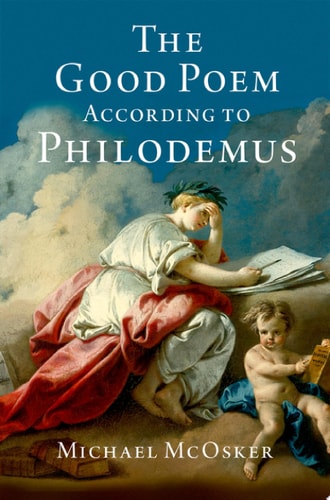
The Good Poem According to Philodemus
0
0
As an Amazon Associate and affiliate partner, Menrva Books earns from qualifying purchases. Learn more
Author Description
This book elucidates the poetics of Philodemus of Gadara, a first century BCE Epicurean philosopher and poet, whose On Poems survives in extensive fragments among the Herculaneum papyri. Although his treatise was primarily polemical and lacks positive exposition, his views are often recoverable from a careful reading of the debates, occasional direct evidence, and attention to his basic Epicurean commitments. His main critical principle is that form and content are inseparable and mutually-reinforcing: a change in one means a change in the other. The poet uses this marriage of form and content to create the psychological effect of the poem in the audience. This effect is hard to pin down exactly. Poems produce "additional thoughts" in the audience, and these entertain them. It seems clear that Philodemus expected good poets to arrange form and content suggestively, so that the poems could exert a lasting pull on the minds of the audience. Additionally, this book summarizes the views of Philodemus' opponents, the technical terminology of literary criticism in the Hellenistic period, and the history of Epicureanism's engagement with poetics. Epicurus did not write an On Poems but Metrodorus did, and this is probably Philodemus' touchstone for his own views. Zeno of Sidon, Demetrius Laco, Siro, and other Epicureans are examined as well. The book concludes with an appendix of topics examined by Philodemus, such as genre, mimesis, "appropriateness," utility, and various technical terms.
Menrva's Summary
THE THESIS
This book investigates the poetics of Philodemus of Gadara to determine how his Epicurean philosophy informs his critical principles regarding the relationship between form and content in poetry. Michael McOsker reconstructs Philodemus's views from fragmented Herculaneum papyri by analyzing his polemical debates against contemporary critics. The author argues that Philodemus viewed the marriage of form and content as the primary mechanism for generating psychological effects and lasting intellectual engagement in the audience.
THE SCOPE MAP
What You Will Find
- Analysis of the Herculaneum papyri fragments concerning Philodemus's On Poems
- Examination of Hellenistic literary criticism terminology and Epicurean engagement with poetics
- Comparative study of Philodemus alongside other Epicureans like Metrodorus, Zeno of Sidon, and Demetrius Laco
- An appendix detailing technical topics including mimesis, genre, and utility
Scope Limits
- The text does not provide a comprehensive positive exposition of Philodemus's poetics, as the original source material is primarily polemical
- The analysis is limited to the surviving fragments and does not attempt to reconstruct lost works in their entirety
THE AUTHORITY PERSPECTIVE
Scholars recognize this work as a significant contribution to the study of Epicurean aesthetics and the interpretation of the Herculaneum papyri. Readers frequently note the academic density of the prose, which is intended for specialists in classical philosophy and literary theory.
Page Count:
624
Publication Date:
2021-01-01
Publisher:
Oxford University Press
ISBN-10:
0190912839
ISBN-13:
9780190912833
Philosophy
Epicureanism
Greek poetry
History & Surveys
Ancient History
Poetics
English & College Success
English
Literary Criticism
Community Tags
Similar Books