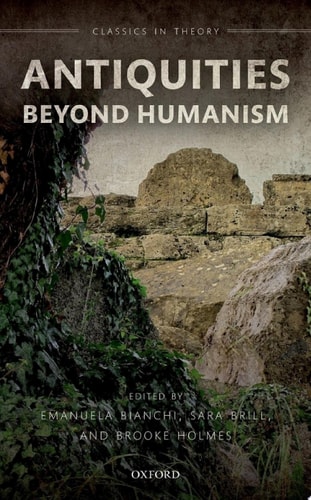
Antiquities Beyond Humanism
0
0
As an Amazon Associate and affiliate partner, Menrva Books earns from qualifying purchases. Learn more
Author Description
Greco-Roman antiquity is often presumed to provide the very paradigm of humanism from the Renaissance to the present. This paradigm has been increasingly challenged by new theoretical currents such as posthumanism and the "new materialisms", which point toward entities, forces, and systems that pass through and beyond the human and dislodge it from its primacy as the measure of things. Antiquities beyond Humanism seeks to explode the presumed dichotomy between the ancient tradition and the twenty-first century "turn" by exploring the myriad ways in which Greek and Roman philosophy and literature can be understood as foregrounding the non-human. Greek philosophy in particular is filled with metaphysical explanations of the cosmos grounded in observations of the natural world, while other areas of ancient humanistic inquiry - poetry, political theory, medicine - extend into the realms of plant, animal, and even stone life, continually throwing into question the ontological status of living and non-living beings. By casting the ancient non-human or more-than-human in a new light in relation to contemporary questions of gender, ecological networks and non-human communities, voice, eros, and the ethics and the politics of posthumanism, the volume demonstrates that encounters with ancient texts, experienced as both familiar and strange, can help forge new understandings of life, whether understood as physical, psychical, divine, or cosmic.
Menrva's Summary
THE THESIS
This volume investigates whether Greco-Roman antiquity, traditionally viewed as the foundation of humanism, contains conceptual frameworks that anticipate contemporary posthumanist and new materialist theories. The editors, Brooke Holmes, Emanuela Bianchi, and Sara Bril, curate a collection of scholarly essays that re-examine ancient philosophy, literature, and medicine. They argue that ancient texts consistently foreground non-human entities, forces, and systems, thereby challenging the modern assumption that the human is the sole measure of all things.
THE SCOPE MAP
What You Will Find
- Analysis of Greek and Roman philosophical texts regarding the cosmos and natural world.
- Exploration of non-human life forms including plants, animals, and inanimate matter in ancient literature.
- Theoretical intersections between ancient ontology and modern discussions on gender, ecology, and ethics.
Scope Limits
- The text does not provide a comprehensive history of humanism itself.
- It does not offer a systematic guide to all ancient philosophical schools, focusing instead on specific posthumanist inquiries.
THE AUTHORITY PERSPECTIVE
Scholars in the field of classics and critical theory recognize this work as a significant intervention in the ongoing dialogue between ancient studies and contemporary philosophy. Readers frequently note the academic density of the prose, which requires a foundational understanding of both classical texts and posthumanist discourse to fully engage with the arguments presented.
Page Count:
320
Publication Date:
2019-01-01
Publisher:
OUP Oxford
ISBN-10:
019252822X
ISBN-13:
9780192528223
Philosophy
Posthumanism
English
English & College Success
Literary theory
Ancient History
History & Surveys
Community Tags
Similar Books