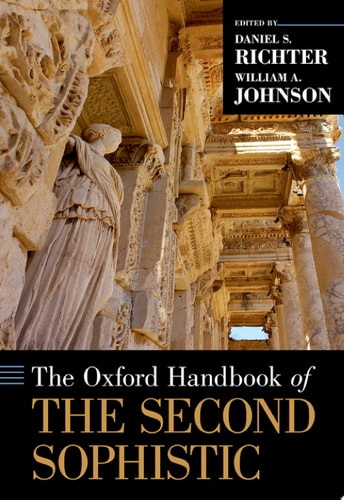
The Oxford Handbook of the Second Sophistic
0
0
As an Amazon Associate and affiliate partner, Menrva Books earns from qualifying purchases. Learn more
Author Description
Focusing on the period known as the Second Sophistic (an era roughly co-extensive with the second century AD), this Handbook serves the need for a broad and accessible overview. The study of the Second Sophistic is a relative new-comer to the Anglophone field of classics and much of what characterizes it temporally and culturally remains a matter of legitimate contestation. The present handbook offers a diversity of scholarly voices that attempt to define, as much as is possible in a single volume, the state of this rapidly developing field. Included are chapters that offer practical guidance on the wide range of valuable textual materials that survive, many of which are useful or even core to inquiries of particularly current interest (e.g. gender studies, cultural history of the body, sociology of literary culture, history of education and intellectualism, history of religion, political theory, history of medicine, cultural linguistics, intersection of the Classical traditions and early Christianity). The Handbook also contains essays devoted to the work of the most significant intellectuals of the period such as Plutarch, Dio Chrysostom, Lucian, Apuleius, the novelists, the Philostrati and Aelius Aristides. In addition to content and bibliographical guidance, however, this volume is designed to help to situate the textual remains within the period and its society, to describe and circumscribe not simply the literary matter but the literary culture and societal context. For that reason, the Handbook devotes considerable space at the front to various contextual essays, and throughout tries to keep the contextual demands in mind. In its scope and in its pluralism of voices this Handbook thus represents a new approach to the Second Sophistic, one that attempts to integrate Greek literature of the Roman period into the wider world of early imperial Greek, Latin, Jewish, and Christian cultural production, and one that keeps a sharp focus on situating these texts within
Menrva's Summary
THE THESIS
This volume investigates the cultural, intellectual, and literary landscape of the Second Sophistic, a period roughly co-extensive with the second century AD. Editors William A. Johnson and Daniel S. Richter compile a diverse collection of scholarly essays to define the parameters of this rapidly evolving field within classical studies. The work synthesizes current research to provide a comprehensive framework for understanding the textual remains of the era and their societal contexts.
THE SCOPE MAP
What You Will Find
- Contextual essays on the literary culture and societal structure of the Roman period.
- Analysis of major intellectuals including Plutarch, Dio Chrysostom, Lucian, and Apuleius.
- Methodological guidance on applying modern inquiries like gender studies, sociology, and the history of medicine to ancient texts.
- Bibliographical resources for further research into imperial Greek, Latin, Jewish, and Christian cultural production.
Scope Limits
- The volume does not provide an exhaustive catalog of every minor text from the period.
- It does not offer a singular, unified definition of the Second Sophistic, acknowledging the ongoing scholarly debate regarding its temporal and cultural boundaries.
THE AUTHORITY PERSPECTIVE
Scholars and students of classics regard this handbook as a foundational reference for navigating the complexities of the Second Sophistic. Readers frequently note the academic density of the prose and the volume's effectiveness in integrating diverse disciplinary approaches to ancient literature.
Page Count:
770
Publication Date:
2017-01-01
Publisher:
Oxford University Press
ISBN-10:
0190855193
ISBN-13:
9780190855192
Classics
Philosophy
History
English
Writing
History & Surveys
Ancient History
Ancient Greece
Roman Empire
Literary Criticism
English & College Success
Community Tags
Similar Books