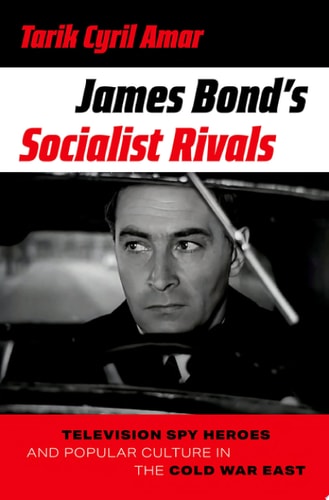
James Bond's Socialist Rivals: Television Spy Heroes and Popular Culture in the Cold War East
0
0
As an Amazon Associate and affiliate partner, Menrva Books earns from qualifying purchases. Learn more
Author Description
In August 1973, the large and growing television audience of the Soviet Union first laid eyes on what would become its quintessential if fictitious hero spy. He was nothing like the West's action man and sex icon James Bond who had risen to global fame in the 1960s. By contrast, Shtirlits made his first appearance as a handsome yet somewhat tired-looking, middle-aged man on a meditative stroll in wintry woods, to the score of a very slow piano rendition of the show's wistful signature theme.The Cold War East, the Soviet Union and its sphere of domination and influence in Eastern Europe, produced a rich array of home-made intelligence heroes who became vastly popular among television audiences in the 1960s and '70s. In this work, Tarik Cyril Amar recovers and analyzes a world of spy fiction entertainment, focusing on three blockbuster series in the former Soviet bloc: Seventeen Moments of Spring (USSR), Stakes Greater Than Life (Poland), and The Invisible Visor (East Germany). Not only did these shows feature secret agents as heroes, but they were also important to party-state authorities, including security and intelligence services, who were combatting Western subversion and deliberately polishing their own image behind the Iron Curtain. The series made reference to World War II, the Holocaust, and the Cold War, shaping public interpretations of historical events and inspiring a rising generation to join intelligence services, including Vladmir Putin. And they remained persistently popular, surviving the collapse of the authoritarian-socialist political regimes under which they had been produced.Based on exhaustive research of unpublished primary sources in archives in Berlin, Moscow, and Warsaw, James Bond's Socialist Rivals offers a more expansive vision of the phenomenon of the spy as popular-culture hero and of the complex nature of Cold War interactions across ideological divisions, geopolitical blocs, and national borders.
Menrva's Summary
THE THESIS
This book investigates how the Soviet bloc utilized television spy dramas to construct heroic archetypes that countered Western cultural influence while simultaneously serving the political and image-building objectives of socialist party-states. Tarik Cyril Amar, a historian specializing in the Cold War, utilizes extensive archival research from Moscow, Berlin, and Warsaw to examine the production and reception of these intelligence narratives. He argues that these shows were not merely entertainment but were strategic tools used to shape public memory of World War II and the Cold War, ultimately influencing generations of citizens and intelligence personnel. The work provides a comparative analysis of how socialist regimes navigated the tension between popular entertainment and state-sanctioned propaganda.
THE SCOPE MAP
What You Will Find
- Analysis of three major television series: Seventeen Moments of Spring, Stakes Greater Than Life, and The Invisible Visor
- Examination of the intersection between intelligence services and state media production
- Historical context regarding the portrayal of the Holocaust and World War II in socialist media
- Discussion of the long-term cultural legacy of these characters post-1989
Scope Limits
- The study focuses primarily on the Soviet Union, Poland, and East Germany, excluding other satellite states
- The analysis is limited to the 1960s and 1970s, not covering the entire duration of the Cold War
THE AUTHORITY PERSPECTIVE
Scholars and historians recognize this work as a significant contribution to the study of Cold War cultural history and the mechanics of state-sponsored media. Readers frequently note the depth of the archival research and the author's ability to contextualize popular entertainment within the broader geopolitical framework of the Eastern Bloc.
Page Count:
304
Publication Date:
2024-11-15
Publisher:
Oxford University Press
ISBN-10:
0190916281
ISBN-13:
9780190916282
History
Television
Russia
Cold War
Media Studies
European History
Community Tags
Similar Books