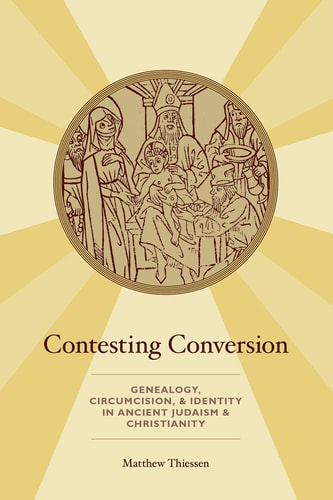
Contesting Conversion: Genealogy, Circumcision, and Identity in Ancient Judaism and Christianity
0
0
As an Amazon Associate and affiliate partner, Menrva Books earns from qualifying purchases. Learn more
Author Description
Winner of the Manfred Lautenschlaeger Award for Theological PromiseMatthew Thiessen offers a nuanced and wide-ranging study of the nature of Jewish thought on Jewishness, circumcision, and conversion. Examining texts from the Hebrew Bible, Second Temple Judaism, and early Christianity, he gives a compelling account of the various forms of Judaism from which the early Christian movement arose.Beginning with analysis of the Hebrew Bible, Thiessen argues that there is no evidence that circumcision was considered to be a rite of conversion to Israelite religion. In fact, circumcision, particularly the infant circumcision practiced within Israelite and early Jewish society, excluded from the covenant those not properly descended from Abraham. In the Second Temple period, many Jews began to subscribe to a definition of Jewishness that enabled Gentiles to become Jews. Other Jews, such as the author of Jubilees, found this definition problematic, reasserting a strictly genealogical conception of Jewish identity. As a result, some Gentiles who underwent conversion to Judaism in this period faced criticism because of their suspect genealogy.Thiessen's examination of the way in which Jews in the Second Temple period perceived circumcision and conversion allows a deeper understanding of early Christianity. Contesting Conversion shows that careful attention to a definition of Jewishness that was based on genealogical descent has crucial implications for understanding the variegated nature of early Christian mission to the Gentiles in the first century C.E.
Menrva's Summary
THE THESIS
This study investigates the historical evolution of Jewish identity, specifically questioning whether circumcision functioned as a rite of conversion or a marker of genealogical descent in ancient Judaism and early Christianity. Matthew Thiessen, a scholar of early Christianity and Second Temple Judaism, utilizes a rigorous analysis of primary texts ranging from the Hebrew Bible to early Christian writings. He argues that early Jewish identity was primarily defined by genealogy, and that the introduction of conversion practices created significant theological and social friction within the early Christian movement.
THE SCOPE MAP
What You Will Find
- Analysis of circumcision practices in the Hebrew Bible and Second Temple period
- Examination of the Book of Jubilees and its stance on genealogical purity
- Historical context regarding the early Christian mission to the Gentiles
- Theological framework for understanding Jewishness in antiquity
Scope Limits
- The study does not provide a comprehensive history of all Jewish sects in the Roman Empire
- It does not focus on modern interpretations of conversion or contemporary Jewish identity
THE AUTHORITY PERSPECTIVE
Scholars and historians recognize this work as a significant contribution to the study of early Christian origins and the development of Jewish identity. Readers frequently note the academic density of the prose and the author's meticulous attention to primary source interpretation.
Page Count:
258
Publication Date:
2018-07-01
Publisher:
Oxford University Press
ISBN-10:
0190912707
ISBN-13:
9780190912703
Religion
History
Theology
Jews identity
Ancient History
Judaism
Christianity