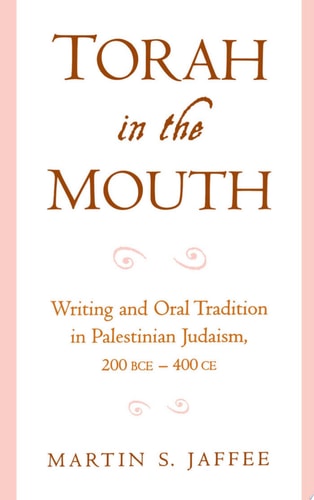
Torah in the Mouth: Writing and Oral Tradition in Palestinian Judaism 200 BCE-400 CE
0
0
As an Amazon Associate and affiliate partner, Menrva Books earns from qualifying purchases. Learn more
Author Description
The classical Rabbinic tradition (legal, discursive, and exegetical) claims to be Oral Torah, transmitted by word of mouth in an unbroken chain deriving its authority ultimately from diving revelation to Moses at Sinai. Since the third century C.E., however, this tradition has been embodied in written texts. Through judicious deployment and analysis of the evidence, Martin Jaffee is able to show that the Rabbinic tradition, as we have it, developed through a mutual interpretation of oral and written modes.
Menrva's Summary
THE THESIS
This work investigates the historical and conceptual tension between the claims of oral transmission in Rabbinic Judaism and the eventual codification of these traditions into written texts. Martin S. Jaffee, a scholar of ancient Judaism, utilizes a rigorous analytical framework to examine how the Rabbinic movement navigated the transition from oral performance to textual authority. By evaluating the interplay between these two modes of communication, Jaffee argues that the Rabbinic tradition was not a static inheritance but a dynamic process of mutual interpretation between oral and written media.
THE SCOPE MAP
What You Will Find
- Analysis of the transition from oral tradition to written Rabbinic texts between 200 BCE and 400 CE.
- Examination of the cultural and legal authority structures within Palestinian Judaism.
- Critical evaluation of the Rabbinic claim regarding the Sinai revelation.
- Methodological framework for understanding the intersection of orality and literacy in antiquity.
THE AUTHORITY PERSPECTIVE
Scholars and students of ancient Judaism frequently cite this text as a foundational study for understanding the development of Rabbinic literature. The prose is noted for its academic precision and its ability to synthesize complex historical evidence into a coherent argument regarding the nature of religious authority.
Page Count:
356
Publication Date:
2001-04-19
Publisher:
Oxford University Press
ISBN-10:
0195140672
ISBN-13:
9780195140675
Religion
History
Theology
Criticism history
Ancient History
Judaism
Community Tags
Similar Books














