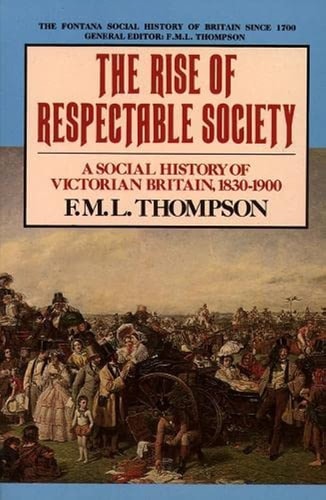
The Rise of Respectable Society: A Social History of Victorian Britain
0
0
As an Amazon Associate and affiliate partner, Menrva Books earns from qualifying purchases. Learn more
Author Description
For the quality of its research and the clarity of its synthesis, The Rise of Respectable Society will gain a reputation as an outstanding reinterpretation of the Victorian period.In the years since the appearance of G. M. Young’s brilliant survey, Victorian England: Portrait of an Age, a mass of new research from new perspectives has entirely changed the landscape of the Victorian era. The Rise of Respectable Society offers a new map of this territory as revealed by close empirical studies of marriage, the family, domestic and working classes from the rigidity of the class stereotypes by which they have been frequently portrayed. But it also argues that the diversity of cultures within those classes was in fact the essence of Victorian society, and that as each class developed its notions of self-respect, so it adhered ever more closely to the classes above and below it, thus avoiding the revolutionary fractures which appeared in many other European countries during this period.
Menrva's Summary
THE THESIS
This work investigates how the Victorian era avoided revolutionary upheaval by examining the development of class-based notions of respectability. F. M. L. Thompson, a distinguished historian of British social and economic life, synthesizes decades of empirical research to challenge traditional, rigid stereotypes of Victorian class structures. He argues that the internal diversity of these classes, coupled with a shared pursuit of self-respect, created a cohesive social fabric that bound different strata of society together rather than driving them apart.
THE SCOPE MAP
What You Will Find
- Detailed analysis of marriage and family structures across different social strata.
- Examination of domestic life and working-class conditions in nineteenth-century Britain.
- Synthesis of empirical studies to re-evaluate class dynamics and social mobility.
- Exploration of the cultural mechanisms that prevented revolutionary fractures common in continental Europe.
THE AUTHORITY PERSPECTIVE
The text is regarded as a significant scholarly reinterpretation of Victorian social history, valued for its rigorous empirical foundation and clear synthesis of complex demographic shifts. Its focus on the nuances of class identity provides a dense, authoritative framework for understanding the stability of British society during a period of rapid industrial change.
Page Count:
384
Publication Date:
1998-09-15
Publisher:
Fontana Press
ISBN-10:
0007291523
ISBN-13:
9780007291526
History
Sociology
Victorian Era
British History
Great Britain
Social History
Community Tags
Similar Books