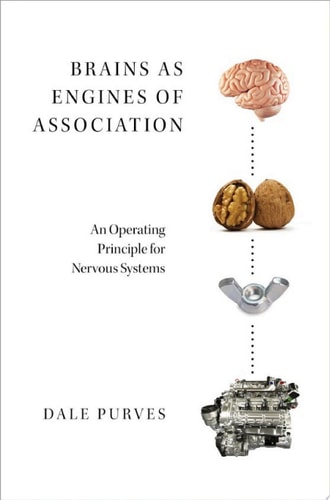
Brains as Engines of Association: An Operating Principle for Nervous Systems
0
0
As an Amazon Associate and affiliate partner, Menrva Books earns from qualifying purchases. Learn more
Author Description
Brains as Engines of Association tackles a fundamental question in neuroscience: what is the operating principle of the human brain? While a similar question has been asked and answered for virtually every other human organ during the last few centuries, how the brain operates has remained a central challenge in biology. Based on evidence derived from vision, audition, speech and music--much of it based on the author's own work over the last twenty years--Brains as Engines of Association argues that brains operate wholly on the basis of trial and error experience, encoded in neural circuitry over evolutionary and individual time. This concept of neural function runs counter to current concepts that view the brain as a computing machine, and research programs based on the idea that the only way to answer such questions is by reconstructing the connectivity of brains in their entirety. This view also implies that the best way to understand the details of brain function is to recapitulate their history using artificial neural networks. While this viewpoint has received support in the last few years from work showing that computers can win complex games, the brain plays a much more complex game--the "game" of biological survival--which Purves concludes is based on trial-and-error experience.
Menrva's Summary
THE THESIS
What is the fundamental operating principle of the human brain, and how does it differ from current computational models? Dale Purves, a prominent neuroscientist, challenges the prevailing view of the brain as a sophisticated computing machine. Drawing on two decades of research in sensory perception, including vision, audition, and speech, he argues that the brain functions primarily as an engine of association built upon trial-and-error experience. This framework posits that neural circuitry is shaped by evolutionary and individual history rather than algorithmic computation.
THE SCOPE MAP
What You Will Find
- Analysis of sensory processing in vision, audition, speech, and music
- A critique of current connectomics and artificial neural network research
- An evolutionary perspective on biological survival as the primary driver of neural development
Scope Limits
- The text does not provide a comprehensive manual for clinical neurology or psychiatric treatment
- It does not offer a detailed technical guide for programming specific artificial intelligence architectures
THE AUTHORITY PERSPECTIVE
Experts recognize this work as a provocative challenge to the dominant computational theory of mind. Readers frequently note the academic density of the prose, which requires a foundational understanding of neurobiology to fully grasp the author's arguments.
Page Count:
210
Publication Date:
2019-01-01
Publisher:
Oxford University Press
ISBN-10:
0190929952
ISBN-13:
9780190929954
Evolutionary Biology
Biology
Neuroscience
Medical
Neurobiology
Brain
Allied Health
Community Tags
Similar Books