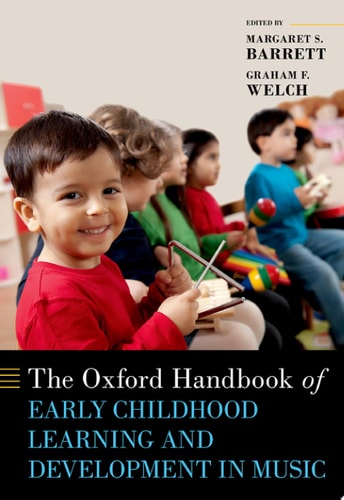
The Oxford Handbook of Early Childhood Learning and Development in Music
0
0
As an Amazon Associate and affiliate partner, Menrva Books earns from qualifying purchases. Learn more
Author Description
Investigation of the role of music in early life and learning has been somewhat fragmented, with studies being undertaken within a range of fields with little apparent conversation across disciplinary boundaries, and with an emphasis on pre-schoolers' and school-aged childrens' learning and engagement. The Oxford Handbook of Early Childhood Learning and Development in Music brings together leading researchers in infant and early childhood cognition, music education, music therapy, neuroscience, cultural and developmental psychology, and music sociology to interrogate questions of how our capacity for music develops from birth, and its contributions to learning and development. Researchers in cultural psychology and sociology of musical childhoods investigate those factors that shape children's musical learning and development and the places and spaces in which children encounter and engage with music. These issues are complemented with consideration of the policy environment at local, national and global levels in relation to music early learning and development and the ways in which these shape young children's music experiences and opportunities. The volume also explores issues of music provision and developmental contributions for children with Special Education Needs, children living in medical settings and participating in music therapy, and those living in sites of trauma and conflict. Consideration of these environments provides a context to examine music learning and development in family, community and school settings including general and specialized school environments. Authors trace the trajectories of development within and across cultures and settings and in that process identify those factors that facilitate or constrain children's early music learning and development.
Menrva's Summary
THE THESIS
This volume investigates how the human capacity for music develops from birth and the subsequent impact of musical engagement on early childhood learning and development. Editors Margaret S. Barrett and Graham F. Welch synthesize research from diverse fields including neuroscience, developmental psychology, and music education to address the historical fragmentation of the discipline. By integrating perspectives from sociology and cultural psychology, the text provides a comprehensive framework for understanding the environmental and policy factors that influence musical acquisition in early life.
THE SCOPE MAP
What You Will Find
- Interdisciplinary analysis of infant and early childhood cognition
- Examination of music provision for children with special educational needs and those in medical or trauma-affected settings
- Evaluation of local, national, and global policy environments regarding music education
- Comparative studies of musical development across various cultural contexts
Scope Limits
- The text does not provide a practical curriculum or instructional manual for classroom teachers
- It does not focus on adolescent or adult musical development beyond the early childhood scope
THE AUTHORITY PERSPECTIVE
Experts identify this volume as a comprehensive reference work that successfully bridges the gap between music education, neuroscience, and sociology. Readers frequently note the academic density of the prose, which is intended for researchers and advanced students in the field of developmental studies.
Page Count:
1072
Publication Date:
2023-01-01
Publisher:
Oxford University Press
ISBN-10:
0190927526
ISBN-13:
9780190927523
Psychology
Music
Music
Music therapy
Neuroscience
Early Childhood
Education
Sociology
Community Tags
Similar Books