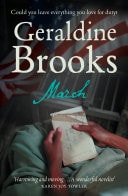
March
0
0
As an Amazon Associate and affiliate partner, Menrva Books earns from qualifying purchases. Learn more
Author Description
Winner of the Pulitzer Prize for Fiction and Richard and Judy pick.From the author of the acclaimed ‘Year of Wonders’ and ‘People of the Book’, a historical novel and love story set during a time of catastrophe on the front lines of the American Civil War.Set during the American Civil War, ‘March’ tells the story of John March, known to us as the father away from his family of girls in ‘Little Women’, Louisa May Alcott’s classic American novel. In Brooks’s telling, March emerges as an abolitionist and idealistic chaplain on the front lines of a war that tests his faith in himself and in the Union cause when he learns that his side, too, is capable of barbarism and racism. As he recovers from a near-fatal illness in a Washington hospital, he must reassemble the shards of his shattered mind and body, and find a way to reconnect with a wife and daughters who have no idea of the ordeals he has been through.As Alcott drew on her real-life sisters in shaping the characters of her little women, so Brooks turned to the journals and letters of Bronson Alcott, Louisa May’s father, an idealistic educator, animal rights exponent and abolitionist who was a friend and confidante of Ralph Waldo Emerson and Henry David Thoreau. The story spans the vibrant intellectual world of Concord and the sensuous antebellum South, through to the first year of the Civil War as the North reels under a series of unexpected defeats.Like her bestselling ‘Year of Wonders’, ‘March’ follows an unconventional love story. It explores the passions between a man and a woman, the tenderness of parent and child, and the life-changing power of an ardently held belief.
Menrva's Summary
THE PULSE
The idealistic chaplain John March faces a profound crisis of faith and identity as he witnesses the brutal realities of the American Civil War. Tasked with serving the Union cause, March finds his moral compass fractured by the violence and systemic racism he encounters on the front lines. The narrative alternates between his harrowing experiences in the field and the domestic life he left behind, utilizing a dual-perspective structure that contrasts the intellectual idealism of Concord with the visceral destruction of the South. As he struggles to recover from illness, he must reconcile the man he was with the man he has become to earn his place back within his family.
INSIDE THE PAGES
- Dual-timeline narrative structure alternating between the Civil War front and pre-war domestic life
- Epistolary elements incorporating letters and journal entries
- Exploration of the philosophical influence of Transcendentalism
- Detailed depiction of 19th-century military hospital conditions
- Character study of an established literary figure from a different perspective
- Examination of the moral complexities of the abolitionist movement
- Sensory-rich descriptions of the antebellum South
- Focus on the psychological toll of war on non-combatant personnel
THE COLLECTIVE ECHO
This novel is widely recognized for its successful expansion of the Alcott mythos, providing a gritty, grounded counterpoint to the domestic warmth of its source material. Critics frequently highlight the author's meticulous research, noting how she integrates the real-life journals of Bronson Alcott to lend authenticity to the protagonist's voice. The reception emphasizes the book's ability to navigate the tension between high-minded idealism and the harsh, often contradictory realities of wartime service. Readers often appreciate the nuanced portrayal of a man struggling to maintain his humanity in the face of institutionalized barbarism. The work is regarded as a significant contribution to the genre of historical fiction for its psychological depth and thematic ambition.
Page Count:
304
Publication Date:
2005-03-01
Publisher:
HarperCollins Publishers
ISBN-10:
0007369220
ISBN-13:
9780007369225
History
Literary Fiction
Romance
Fiction
Historical Fiction
War & Military
Family life
American
War
United States
Fathers and daughters
Literary Criticism
Family fiction
Medical
Classics
Personal Memoirs
Historical
War fiction
Military
Fiction
Biography Autobiography
Community Tags
Similar Books