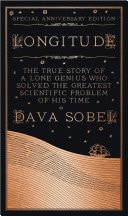
Longitude
0
0
As an Amazon Associate and affiliate partner, Menrva Books earns from qualifying purchases. Learn more
Author Description
The dramatic human story of an epic scientific quest: the search for the solution of how to calculate longitude and the unlikely triumph of an English genius. With a Foreword by Neil Armstrong.‘Sobel has done the impossible and made horology sexy – no mean feat’ New ScientistAnyone alive in the 18th century would have known that ‘the longitude problem’ was the thorniest scientific dilemma of the day – and had been for centuries. Lacking the ability to measure their longitude, sailors throughout the great ages of exploration had been literally lost at sea as soon as they lost sight of land. Thousands of lives, and the increasing fortunes of nations, hung on a resolution.The quest for a solution had occupied scientists and their patrons for the better part of two centuries when, in 1714, Parliament upped the ante by offering a king’s ransom (£20,000) to anyone whose method or device proved successful. Countless quacks weighed in with preposterous suggestions. The scientific establishment throughout Europe – from Galileo to Sir Isaac Newton – had mapped the heavens in both hemispheres in its certain pursuit of a celestial answer. In stark contrast, one man, John Harrison, dared to imagine a mechanical solution.Full of heroism and chicanery, brilliance and the absurd, LONGITUDE is also a fascinating brief history of astronomy, navigation and clockmaking.Note that it has not been possible to include the same picture content that appeared in the original print version.
Menrva's Summary
THE THESIS
This book investigates the historical crisis of maritime navigation caused by the inability to determine longitude at sea and the subsequent race to solve this problem through mechanical innovation. Dava Sobel, a former science reporter for The New York Times, utilizes historical records and biographical research to document the life of John Harrison. She contrasts the rigid, celestial-focused scientific establishment of the 18th century with Harrison's solitary, mechanical approach to creating a timekeeping device capable of enduring long sea voyages.
THE SCOPE MAP
What You Will Find
- The 18th-century scientific and political landscape surrounding the Longitude Act of 1714.
- Detailed technical evolution of marine chronometers and clockmaking mechanics.
- Biographical analysis of John Harrison's struggle against the Board of Longitude.
- Historical context of global exploration and the human cost of navigational failure.
THE AUTHORITY PERSPECTIVE
This work is widely regarded as a model of accessible science writing that successfully distills complex horological history into a compelling narrative. The text is frequently cited for its ability to humanize the technical challenges of the Enlightenment era while maintaining historical rigor.
Page Count:
208
Publication Date:
2011-04-28
Publisher:
HarperCollins Publishers
ISBN-10:
0007382006
ISBN-13:
9780007382002
Science & Technology
Science
Biography
History
20th Century
Technology & Engineering
Clocks & chronometers
Manufacturing
Maritime history
Mathematics
ScienceMathematics
Horology
Navigation
Modern
Science & Math
Social History
Inventions
c 1700 to c 1800
Military
Biography Autobiography
Study & Teaching
England
Expeditions & Discoveries
Science
Transportation
Naval
Community Tags
Other Editions(4)

Similar Books














Reader Comments
Share Your Thoughts
No comments yet. Be the first to share your thoughts!