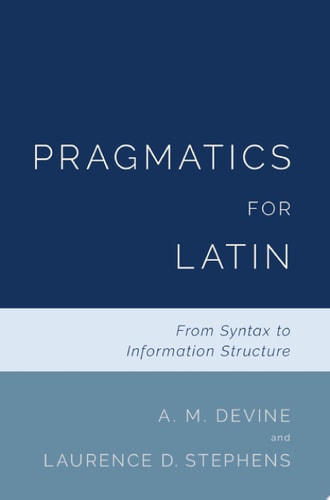
Pragmatics for Latin
0
0
As an Amazon Associate and affiliate partner, Menrva Books earns from qualifying purchases. Learn more
Author Description
Latin Is Often Described As A Free Word Order Language, But In General Each Word Order Encodes A Particular Information Structure: In That Sense, Each Word Order Has A Different Meaning. Pragmatics For Latin Provides A Descriptive Analysis Of Latin Information Structure Based On Detailed Philological Evidence And Elaborates A Syntax-pragmatics Interface That Formalizes The Informational Content Of The Various Different Word Orders. Using A Slightly Adjusted Version Of The Structured Meanings Theory, The Book Shows How The Pragmatic Meanings Matching The Different Word Orders Arise Naturally And Spontaneously Out Of The Compositional Process As An Integral Part Of A Single Semantic Derivation Covering Denotational And Informational Meaning At One And The Same Time.
Menrva's Summary
THE THESIS
This book investigates how Latin word order functions as a mechanism for encoding information structure rather than operating as a purely free syntactic system. The authors, A. M. Devine and Laurence D. Stephens, utilize extensive philological evidence to construct a formal syntax-pragmatics interface. By applying a modified version of the structured meanings theory, they argue that pragmatic meaning is an inherent, compositional component of semantic derivation in Latin.
THE SCOPE MAP
What You Will Find
- A formal analysis of the syntax-pragmatics interface in Latin.
- Application of the structured meanings theory to classical linguistic structures.
- Detailed philological evidence supporting the informational function of word order.
Scope Limits
- The analysis focuses primarily on the informational structure rather than broader historical or sociolinguistic contexts of the language.
THE AUTHORITY PERSPECTIVE
Scholars and linguists recognize this work as a rigorous, technical examination of Latin syntax that moves beyond traditional descriptive grammar. Readers frequently note the academic density of the prose, which is intended for advanced students and specialists in classical philology.
Page Count:
200
Publication Date:
2019-01-01
Publisher:
Oxford University Press
ISBN-10:
0190939486
ISBN-13:
9780190939489
Latin Language
Philology
Syntax
Pragmatics
Linguistics
Community Tags
Similar Books