Author Description
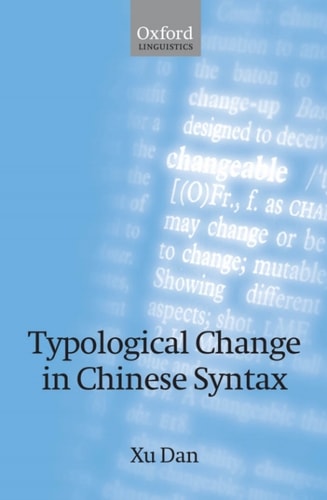
This new interpretation of the early history of Chinese argues that Old Chinese was typologically a 'mixed' language. It shows that, though its dominant word order was subject-verb-object, this coexisted with subject-object-verb. Professor Xu demonstrates that Old Chinese was not the analytic language it has usually been assumed to be, and that it employed morphological and lexical devices as well as syntactic means. She describes the typological changes that have taken place since the Han period and shows how Chinese evolved into a more analytic language, supporting her exposition with abundant examples. She draws where possible on archaeological findings in order to distinguish between versions of texts transmitted and sometimes modified through the hands of generations of copyists. The author focusses on syntactic issues, including word order, verbs, causative structures, resultative compounds, and negation, but also pays close attention to what she demonstrates are closely related changes in phonology and the writing system. The book will interest scholars and graduate students of Chinese linguistics, philology, classical literature as well as general linguists interested in word-order typology and language universals. It may be also be used as a text for advanced courses in Classical Chinese and Chinese diachronic syntax.
Menrva's Summary
THE THESIS
This book investigates the historical evolution of Chinese syntax to challenge the traditional classification of Old Chinese as a purely analytic language. Professor Dan Xu utilizes a combination of linguistic analysis and archaeological evidence to argue that Old Chinese functioned as a typologically mixed language. By examining the transition from the Han period to the present, the author demonstrates how the language shifted its word order and morphological structures over time.
THE SCOPE MAP
What You Will Find
- Analysis of word order shifts between subject-verb-object and subject-object-verb patterns
- Examination of causative structures, negation, and resultative compounds
- Integration of archaeological findings to verify textual accuracy against modified manuscripts
- Discussion on the interplay between syntactic, phonological, and writing system changes
Scope Limits
- The text focuses primarily on diachronic syntax and does not provide an exhaustive history of Chinese literature or culture
- The analysis is intended for advanced students and scholars rather than casual readers
THE AUTHORITY PERSPECTIVE
Experts recognize this work as a significant contribution to the study of Chinese diachronic syntax and language typology. Scholars frequently note the academic density of the prose, making it a specialized resource for graduate-level research in linguistics and philology.
Page Count:
272
Publication Date:
2006-01-01
Publisher:
OUP Oxford
ISBN-10:
0191516384
ISBN-13:
9780191516382
Philology
English
Syntax
English & College Success
Chinese Linguistics
Historical linguistics
Academic
Linguistics
Community Tags
Similar Books