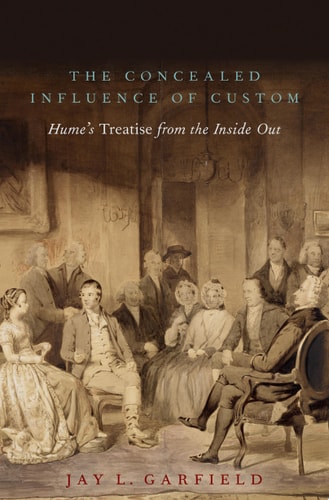
The Concealed Influence of Custom
0
0
As an Amazon Associate and affiliate partner, Menrva Books earns from qualifying purchases. Learn more
Author Description
Jay L. Garfield Defends Two Exegetical Theses Regarding Hume's Treatise On Human Nature. The First Is That Book Ii Is The Theoretical Foundation Of The Treatise. Second, Garfield Argues That We Cannot Understand Hume's Project Without An Appreciation Of His Own Understanding Of Custom, And In Particular, Without An Appreciation Of The Grounding Of His Thought About Custom In The Legal Theory And Debates Of His Time. Custom Is The Source Of Hume's Thoughts About Normativity, Not Only In Ethics And In Political Theory, But Also In Epistemological, Linguistics, And Scientific Practice- And Is The Source Of His Insight That Our Psychological And Social Natures Are So Inextricably Linked. The Centrality Of Custom And The Link Between The Psychological And The Social Are Closely Connected, Which Is Why Garfield Begins With Book Ii. There Are Four Interpretative Perspectives At Work In This Volume: One Is A Naturalistic Skeptical Interpretation Of Hume's Treatise; A Second Is The Foregrounding Of Book Ii Of The Treatise As Foundational For Books I And Iii. A Third Is The Consideration Of The Treatise In Relation To Hume's Philosophical Antecedents (particularly Sextus, Bayle, Hutcheson, Shaftesbury, And Mandeville), As Well As Eighteenth Century Debates About The Status Of Customary Law, With One Eye On Its Sequellae In The Work Of Kant, The Later Wittgenstein, And In Contemporary Cognitive Science. The Fourth Is The Buddhist Tradition In Which Many Of The Ideas Hume Develops Are Anticipated And Articulated In Somewhat Different Ways. Garfield Presents Hume As A Naturalist, A Skeptic And As, Above All, A Communitarian. In Offering This Interpretation, He Provides An Understanding Of The Text As A Whole In The Context Of The Literature To Which It Responded, And In The Context Of The Literature It Inspired.
Menrva's Summary
THE THESIS
This volume investigates the central role of custom in David Hume's 'A Treatise of Human Nature' to argue that Book II serves as the foundational pillar for his entire philosophical project. Jay L. Garfield, a prominent scholar in comparative philosophy, utilizes a multi-disciplinary framework to demonstrate that Hume's understanding of normativity—spanning ethics, politics, and epistemology—is rooted in the legal and social theories of the eighteenth century. By re-centering the text on Book II, Garfield contends that Hume's psychological and social insights are inextricably linked, providing a cohesive reading of the Treatise that bridges historical context with contemporary cognitive science.
THE SCOPE MAP
What You Will Find
- A re-evaluation of the structural hierarchy of Hume's 'A Treatise of Human Nature'.
- An analysis of the influence of legal theory and customary law on Hume's normative framework.
- Comparative studies linking Hume's work to Sextus, Bayle, Hutcheson, Shaftesbury, Mandeville, Kant, and Wittgenstein.
- A cross-cultural perspective integrating Buddhist philosophical traditions with Humean skepticism.
Scope Limits
- The text does not provide a general introduction to Hume for absolute beginners.
- It does not offer an exhaustive biography of Hume's life outside of his intellectual development.
THE AUTHORITY PERSPECTIVE
Scholars and students of philosophy frequently note the academic density of the prose, which requires a strong familiarity with the original Treatise. Experts highlight this as a significant contribution to Humean scholarship, particularly for its innovative synthesis of Western naturalism and Eastern philosophical parallels.
Page Count:
288
Publication Date:
2019-01-01
Publisher:
Oxford University Press
ISBN-10:
0190933410
ISBN-13:
9780190933418
Philosophy
Political Theory
Ethics
Philosophy history
David Hume
Epistemology
Community Tags
Similar Books