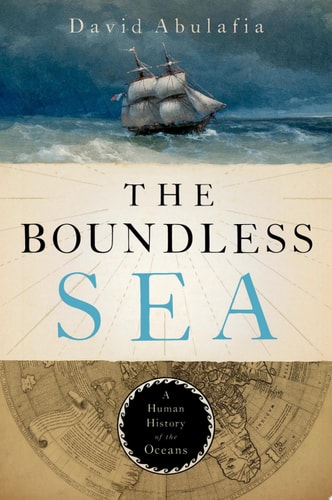
The Boundless Sea: A Human History of the Oceans
0
0
As an Amazon Associate and affiliate partner, Menrva Books earns from qualifying purchases. Learn more
Author Description
From the beginning of history to the present, a sweep of the world's oceans and seas and how they have shaped the course of civilization. From the author of the acclaimed The Great Sea, ("Magnificent... radiates scholarship and a sense of wonder and fun," Simon Sebag Montefiore; Book of the Year, The Economist), David Abulafia's new book guides readers along the world's greatest bodies of water to reveal their primary role in human history. The main protagonists are the three major oceans--the Atlantic, the Pacific, and the Indian--which together comprise the majority of the earth's water and cover over half of its surface. Over time, as passage through them gradually extended and expanded, linking first islands and then continents, maritime networks developed, evolving from local exploration to lines of regional communication and commerce and eventually to major arteries. These waterways carried goods, plants, livestock, and of course people--free and enslaved--across vast expanses, transforming and ultimately linking irrevocably the economies and cultures of Africa, Europe, Asia, and the Americas. Far more than merely another history of exploration, The Boundless Sea shows how maritime networks gradually formed a continuum of interaction and interconnection. Working chronologically, Abulafia moves from the earliest forays of peoples taking hand-hewn canoes into uncharted waters, to the routes taken daily by supertankers in the thousands. History on the grandest scale and scope, written with passion and precision, this is a project few could have undertaken. Abulafia, whom The Atlantic calls "superb writer with a gift for lucid compression and an eye for the telling detail," proves again why he ranks as one of the world's greatest storytellers.
Menrva's Summary
THE THESIS
This work investigates how the world's oceans and seas have functioned as the primary arteries for human civilization, trade, and cultural exchange throughout history. David Abulafia, a distinguished historian, utilizes a vast array of archaeological, economic, and historical records to argue that maritime networks are the fundamental connectors of global development. By tracing the evolution of water-based travel from primitive canoes to modern industrial shipping, the author demonstrates how these bodies of water transformed isolated societies into an interconnected global system.
THE SCOPE MAP
What You Will Find
- A chronological analysis of maritime expansion across the Atlantic, Pacific, and Indian Oceans.
- Examination of the movement of goods, livestock, plants, and human populations, including the impact of the slave trade.
- Analysis of the transition from local coastal exploration to complex international commercial networks.
Scope Limits
- The text focuses primarily on the macro-level development of maritime networks rather than the granular details of individual naval battles or specific ship technologies.
THE AUTHORITY PERSPECTIVE
Scholars and critics frequently commend the book for its immense scale and the author's ability to synthesize complex historical data into a coherent narrative. Readers often note the academic density of the prose, which provides a comprehensive overview suitable for those interested in global history and economic development.
Page Count:
1082
Publication Date:
2019-01-01
Publisher:
Oxford University Press
ISBN-10:
0190933135
ISBN-13:
9780190933135
History
Maritime history
Geography
Trade Routes
Trade
Exploration
World history
World Civilization
Community Tags
Other Editions(2)

Similar Books