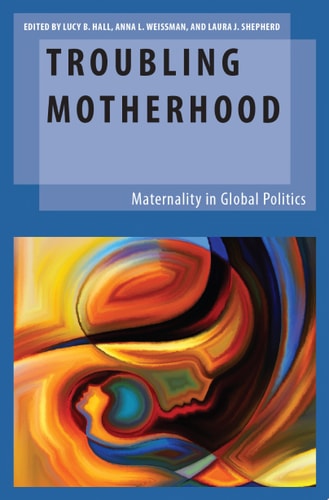
Troubling Motherhood: Maternality in Global Politics
0
0
As an Amazon Associate and affiliate partner, Menrva Books earns from qualifying purchases. Learn more
Author Description
In global politics, women's bodies are policed, objectified, surveilled, and feared, with particular attention paid to both their met or unmet procreative potential. While the significance of motherhood varies across cultures, it is, as this book argues, connected not just to gender and sexuality, but also to religion and nationality. Reproduction is central to the flourishing of any nation or culture, and therefore motherhood is a major signifier of women's relationship to the state. This is so much the case that states enact laws about which women can bear children and have supported sterilization efforts in cases where women are not deemed appropriate bearers of the nation. States also legislate reproductive technologies, adoption, and government support for parenting.By considering representations and narratives of maternity, this volume shows how practices of global politics shape and are shaped by the gendered norms and institutions that underpin motherhood. Motherhood matters in global politics. Yet, the diverse ways in which performances and practices of motherhood are constituted by and are constitutive of other dimensions of political life are frequently obscured, or assumed to be of little interest to scholars, policymakers, and practitioners.Featuring innovative and diverse chapters on the politics of motherhood as an institution, this collection shows that maternality is troubled, complicated, and heterogeneous in global politics. Thus, performances and practices of motherhood warrant closer and more sustained scrutiny. This book builds on work by feminist international relations scholars, extending into disruptive spaces of queer theory, literary critique, and post-colonial studies. The chapters in this book consider the meaning of motherhood, particularly during times of war versus peace; the connections between motherhood and nationhood (and reproduction of the state); and care work and maternal labor, particularly as performed by transnational workers.
Menrva's Summary
THE THESIS
This volume investigates how the institution of motherhood functions as a critical, yet often overlooked, site of power and regulation within global political structures. The authors, including scholars Anna L. Weissman, Lucy B. Hall, and Laura J. Shepherd, synthesize feminist international relations theory with queer theory, literary critique, and post-colonial studies. They argue that maternality is not a static biological fact but a heterogeneous political performance that states actively manage to define national identity, reproductive rights, and labor hierarchies.
THE SCOPE MAP
What You Will Find
- Analysis of state-level legislation regarding reproductive technologies and adoption.
- Examination of the intersection between motherhood, nationalism, and state-sanctioned sterilization.
- Comparative studies of maternal labor and care work performed by transnational workers.
- Theoretical frameworks connecting gendered norms to international political institutions.
Scope Limits
- The text focuses primarily on institutional and structural politics rather than individual psychological accounts of parenting.
- It does not provide an exhaustive global survey of every cultural variation of motherhood.
THE AUTHORITY PERSPECTIVE
Scholars in the field of gender and international relations identify this work as a significant contribution to the study of how domestic reproductive politics inform global statecraft. Readers frequently note the academic density of the prose, which is intended for researchers and practitioners familiar with feminist political theory.
Page Count:
324
Publication Date:
2019-01-01
Publisher:
Oxford University Press
ISBN-10:
0190939206
ISBN-13:
9780190939205
Parenting
Gender Studies
Cultural Anthropology
Sociology
Family & Consumer Sciences
Feminist Theory
International relations
Community Tags
Other Editions(2)
Similar Books















Reader Comments
Share Your Thoughts
No comments yet. Be the first to share your thoughts!