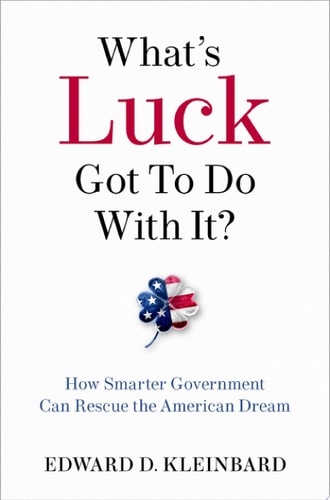
What's Luck Got to Do with It: How Smarter Government Can Rescue the American Dream
0
0
As an Amazon Associate and affiliate partner, Menrva Books earns from qualifying purchases. Learn more
Author Description
The American dream of equal opportunity is in peril. America's economic inequality is shocking, poverty threatens to become a heritable condition, and our healthcare system is crumbling despite ever increasing costs.In this thought-provoking book, Edward D. Kleinbard demonstrates how the failure to acknowledge the force of brute luck in our material lives exacerbates these crises ― leading to warped policy choices that impede genuine equality of opportunity for many Americans. What's Luck Got to Do with It? combines insights from economics, philosophy, and social psychology to argue for government's proper role in addressing the inequity of brute luck. Kleinbard shows how well-designed public investment can blunt the worst effects of existential bad luck that private insurance cannot reach and mitigate inequality by sharing the costs across the entire risk pool, which is to say, all of us. The benefits, as Kleinbard shares in a wealth of data, are economic as well as social ― a more inclusive economy, higher national income, and greater life satisfaction for millions of Americans.Like it or not, our lives and opportunities are determined largely by luck. Kleinbard shows that while we can't undo every instance of misfortune, we can offer a path to not just a fairer America, but greater economic growth, more broadly shared.
Menrva's Summary
THE THESIS
This book investigates how the failure to account for the role of luck in economic outcomes leads to ineffective public policy and the erosion of equal opportunity in America. Edward D. Kleinbard, a professor of law and business, utilizes a multidisciplinary approach to argue that government intervention is necessary to mitigate the arbitrary effects of misfortune. By synthesizing economic data with philosophical inquiry, he proposes a framework for public investment that shares risk across the population to foster a more inclusive and productive economy.
THE SCOPE MAP
What You Will Find
- Analysis of economic inequality and its impact on social mobility
- Theoretical framework for public investment as a risk-sharing mechanism
- Integration of economic, philosophical, and social psychological perspectives
Scope Limits
- Does not provide a comprehensive legislative roadmap for specific policy implementation
- Focuses primarily on the American economic and political context rather than global systems
THE AUTHORITY PERSPECTIVE
Experts and readers recognize this work as a significant contribution to the discourse on public finance and social equity. The text is noted for its accessible synthesis of complex economic theory and its clear argument for the role of government in addressing systemic inequality.
Page Count:
320
Publication Date:
2021-02-08
Publisher:
Oxford University Press
ISBN-10:
0190943572
ISBN-13:
9780190943578
Economics
Public Policy
American Government
Community Tags
Similar Books