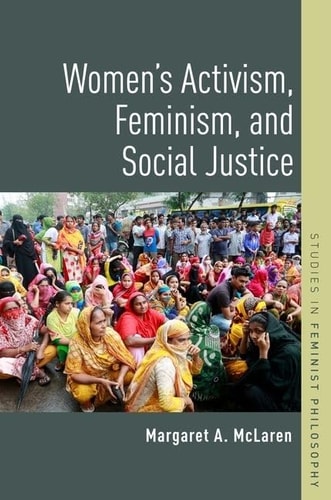
Women's Activism, Feminism, and Social Justice
0
0
As an Amazon Associate and affiliate partner, Menrva Books earns from qualifying purchases. Learn more
Author Description
A wide range of issues besieges women globally, including economic exploitation, sexist oppression, racial, ethnic, and caste oppression, and cultural imperialism. This book builds a feminist social justice framework from practices of women's activism in India to understand and work to overcome these injustices. The feminist social justice framework provides an alternative to mainstream philosophical frameworks that promote global gender justice: for example, universal human rights, economic projects such as microfinance, and cosmopolitanism. McLaren demonstrates that these frameworks are bound by a commitment to individualism and an abstract sense of universalism that belies their root neo-liberalism. Arguing that these frameworks emphasize individualism over interdependence, similarity over diversity, and individual success over collective capacity, McLaren draws on the work of Rabindranath Tagore to develop the concept of relational cosmopolitanism.Relational cosmopolitanism prioritizes our connections while, crucially, acknowledging the reality of power differences. Extending Iris Young's theory of political responsibility, McLaren shows how Fair Trade connects to the economic solidarity movement. The Self-Employed Women's Association and MarketPlace India empower women through access to livelihoods as well as fostering leadership capabilities that allow them to challenge structural injustice through political and social activism. Their struggles to resist economic exploitation and gender oppression through collective action show the vital importance of challenging individualist approaches to achieving gender justice. The book is a rallying call for a shift in our thinking and practice towards re-imagining the possibilities for justice from a relational framework, from independence to interdependence, from identity to intersectionality, and from interest to socio-political imagination.
Menrva's Summary
THE THESIS
This book investigates how mainstream global gender justice frameworks fail to address systemic oppression and proposes a new feminist social justice model based on relational cosmopolitanism. Margaret A. McLaren, a scholar in feminist philosophy, critiques the neo-liberal foundations of universal human rights and microfinance initiatives. By analyzing the practices of women's activism in India, she argues for a shift from individualistic approaches toward a framework rooted in interdependence, intersectionality, and collective capacity.
THE SCOPE MAP
What You Will Find
- A critique of neo-liberalism in global gender justice projects.
- The development of the concept of relational cosmopolitanism based on Rabindranath Tagore's work.
- Case studies of the Self-Employed Women's Association and MarketPlace India.
- An extension of Iris Young's theory of political responsibility applied to Fair Trade.
Scope Limits
- The analysis is primarily focused on specific activist practices within the Indian context.
- The text does not provide a comprehensive survey of all global feminist movements outside of the identified economic solidarity models.
THE AUTHORITY PERSPECTIVE
Scholars in the field of feminist philosophy recognize this work as a significant contribution to the critique of Western-centric justice frameworks. Readers frequently note the academic density of the prose, which is intended for advanced students and researchers in political theory and gender studies.
Page Count:
290
Publication Date:
2019-09-12
Publisher:
Oxford University Press
ISBN-10:
0190947691
ISBN-13:
9780190947699
Philosophy
Global Studies
Sociology
Social justice
India
Feminist Philosophy
Womens rights
Gender Studies
Community Tags
Other Editions(2)
Similar Books














Reader Comments
Share Your Thoughts
No comments yet. Be the first to share your thoughts!