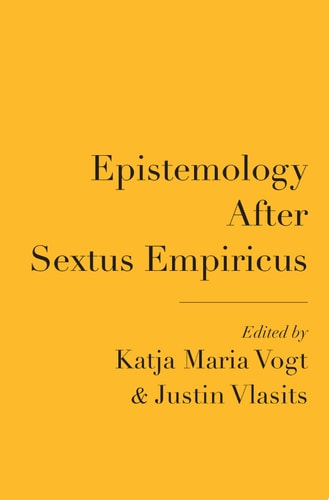
Epistemology After Sextus Empiricus
0
0
As an Amazon Associate and affiliate partner, Menrva Books earns from qualifying purchases. Learn more
Author Description
Sextus Empiricus was the voice of ancient Greek skepticism for posterity. His writings contain the most subtle and detailed versions of the ancient skeptical arguments known as Pyrrhonism, adding up to a distinctive philosophical approach. Instead of viewing philosophy as valuable because of the answers it gives to important questions, Sextus considered the search for answers itself to be fundamental and offered a philosophy centered on inquiry. Assuming the point of view of an active inquirer, Sextus developed arguments concerning conflicting appearances, infinite regress in argument, dogmatic assertion of premises that are insufficiently justified, and many other ideas that fascinated later philosophers of knowledge across the centuries. He provided a unique perspective on topics of enduring relevance such as perception, language, logical consequence, belief, ignorance, disagreement, and induction.While Sextus's importance to epistemology was appreciated by early modern and modern philosophers, he is underrepresented in contemporary discussions. In order to put Sextus back in the center of epistemology, these essays discuss his influence in the history of modern philosophy as well as contemporary engagements with Sextus's version of Pyrrhonian skepticism. The contributors investigate epistemology after Sextus, addressing four core themes of Sextus's skepticism: appearances and perception, the structure of justification and proof, belief and ignorance, and ethics and action. The arguments presented here bridge the divide between contemporary and ancient debates about knowledge and skepticism and will appeal to philosophers interested in epistemology and philosophy of mind as well as those interested in ancient philosophy and the history of philosophy more generally.
Menrva's Summary
THE THESIS
This collection of essays investigates the enduring relevance of Sextus Empiricus’s Pyrrhonian skepticism and its capacity to inform contemporary epistemological debates. Editors Justin Vlasits and Katja Maria Vogt, both established scholars in the field of ancient philosophy, curate a series of contributions that analyze how Sextus’s focus on inquiry—rather than dogmatic assertion—challenges modern philosophical frameworks. By bridging the gap between ancient skepticism and current discourse, the authors argue that Sextus provides a necessary corrective to modern approaches regarding justification, belief, and the nature of knowledge.
THE SCOPE MAP
What You Will Find
- Historical analysis of Sextus Empiricus’s influence on early modern and modern philosophy.
- Contemporary engagements with Pyrrhonian arguments concerning infinite regress and conflicting appearances.
- Examination of four core themes: appearances and perception, the structure of justification and proof, belief and ignorance, and ethics and action.
Scope Limits
- The text does not provide a comprehensive biography of Sextus Empiricus.
- It does not cover non-Western skeptical traditions or comparative Eastern philosophy.
THE AUTHORITY PERSPECTIVE
Experts identify this volume as a significant contribution to the revival of interest in Pyrrhonism within analytic epistemology. Readers frequently note the academic density of the prose, which is intended for advanced students and professional philosophers familiar with the history of philosophy.
Page Count:
347
Publication Date:
2019-01-01
Publisher:
Oxford University Press
ISBN-10:
0190946326
ISBN-13:
9780190946326
Philosophy
Philosophy history
Mind & Body
Influence Literary artistic etc
Skepticism
Knowledge Theory
Epistemology
Sextus
History & Surveys
Community Tags
Other Editions(2)

Similar Books



Reader Comments
Share Your Thoughts
No comments yet. Be the first to share your thoughts!