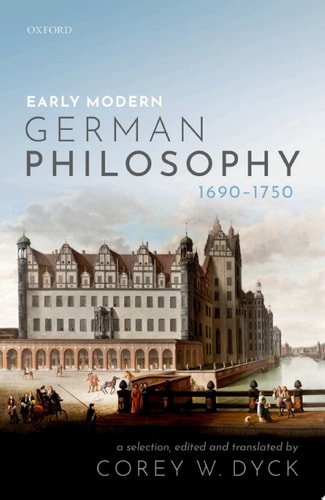
Early Modern German Philosophy (1690-1750)
0
0
As an Amazon Associate and affiliate partner, Menrva Books earns from qualifying purchases. Learn more
Author Description
Early Modern German Philosophy (1690-1750) makes some of the key texts of early German thought available in English, in most cases for the first time. The translations range from texts by the most important figures of the period, including Christian Thomasius, Christian Wolff, Christian August Crusius, and Georg Friedrich Meier, as well as texts by consequential but less familiar thinkers such as Dorothea Christiane Erxleben, Theodor Ludwig Lau, Friedrich Wilhelm Stosch, and Joachim Lange. The topics covered range across a number of areas of theoretical philosophy, including metaphysics (the immortality of the soul, materialism and its refutation, the pre-established harmony), epistemology (the principle of sufficient reason, the limits of reason with respect to matters of faith), and logic (the role of prejudices in cognition and the doctrine of truth). These texts are intended to showcase German philosophy in the early Modern period as a far richer tradition than it is typically given credit for, and indeed as much more than either a footnote to Leibniz or merely a step on the way to Kant. This collection is a valuable resource for students and scholars interested in the early modern German tradition and the often neglected works that enlightened it.
Menrva's Summary
THE THESIS
This volume investigates the breadth and depth of early modern German philosophy between 1690 and 1750, challenging the perception that this period serves merely as a bridge between Leibniz and Kant. Corey W. Dyck, a specialist in the history of German philosophy, curates a collection of primary source translations to demonstrate that this era possessed a distinct and robust intellectual tradition. By presenting these texts in English, the author argues for the significance of both canonical figures and marginalized thinkers in shaping the development of theoretical philosophy.
THE SCOPE MAP
What You Will Find
- Primary source translations of works by Christian Thomasius, Christian Wolff, Christian August Crusius, and Georg Friedrich Meier.
- Philosophical writings from lesser-known figures including Dorothea Christiane Erxleben, Theodor Ludwig Lau, Friedrich Wilhelm Stosch, and Joachim Lange.
- Analysis of core theoretical topics such as the immortality of the soul, materialism, the principle of sufficient reason, and the limits of reason regarding faith.
Scope Limits
- The collection is strictly bounded by the 1690–1750 timeframe.
- The text focuses primarily on theoretical philosophy rather than political or social philosophy.
THE AUTHORITY PERSPECTIVE
Scholars and students of the early modern period identify this collection as a vital resource for accessing previously untranslated primary sources. Experts highlight the text as a necessary corrective to the traditional historiography that often overlooks the complexity of the German intellectual landscape during this era.
Page Count:
288
Publication Date:
2019-01-01
Publisher:
OUP Oxford
ISBN-10:
0192524925
ISBN-13:
9780192524928
Philosophy
Logic
Epistemology
Mind & Body
Metaphysics
Early Modern
Philosophy history
German Philosophy
Community Tags
Similar Books