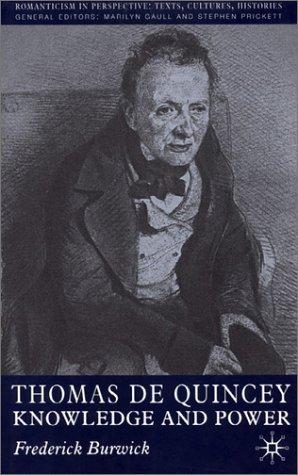
Thomas De Quincey
0
0
As an Amazon Associate and affiliate partner, Menrva Books earns from qualifying purchases. Learn more
Author Description
This book examines what De Quincey called 'psychological criticism', a mode of studying the 'power' of Shakespeare and Wordsworth, tracing the effects upon the subconscious. That psychological ground is established in his discrimination of 'literature of knowledge' and 'literature of power', and is subsequently developed in his 'reader response' mode of evoking Shakespearean and Miltonic excellence and the literary merits of Wordsworth and Coleridge. Each chapter examines aspects of the extensive repertory of contraries which inform De Quincey's critical and narrative prose, including his skilled rewriting of a German forgery of a Waverly novel, intended to 'hoax the hoaxer'. Other chapters deal with better-known works: 'Suspiria de Profundis', 'Murder Considered as on of the Fine Arts', 'On the Knocking at the Gate in Macbeth', 'The English Mail-Coach', and 'Wordsworth's Poetry'. New insight into each of these works is provided by drawing on a wealth of unpublished manuscripts.--BOOK JACKET.
Menrva's Summary
THE THESIS
This book investigates Thomas De Quincey's concept of 'psychological criticism' and its application to the works of major literary figures. Frederick Burwick, an established scholar, analyzes De Quincey's distinction between 'literature of knowledge' and 'literature of power' to understand how De Quincey explored the subconscious effects of literature. The study delves into De Quincey's critical and narrative prose, examining his engagement with Shakespeare, Wordsworth, Coleridge, and Milton, as well as his own lesser-known and more famous writings.
THE SCOPE MAP
- Analysis of De Quincey's 'psychological criticism' and its theoretical underpinnings.
- Examination of the 'literature of knowledge' versus 'literature of power' distinction.
- Exploration of De Quincey's 'reader response' approach to literary analysis.
- Detailed study of De Quincey's engagement with Shakespeare, Wordsworth, Coleridge, and Milton.
- Discussion of De Quincey's skilled rewriting of a German forgery of a Waverly novel.
- In-depth analysis of De Quincey's essays: 'Suspiria de Profundis', 'Murder Considered as on of the Fine Arts', 'On the Knocking at the Gate in Macbeth', 'The English Mail-Coach', and 'Wordsworth's Poetry'.
- Insights drawn from a wealth of unpublished manuscripts.
THE AUTHORITY PERSPECTIVE
The book offers a scholarly examination of Thomas De Quincey's critical theories, particularly his concept of 'psychological criticism'. It is likely to be appreciated by academics and students of English literature who are interested in De Quincey's unique approach to analyzing the power of literary works. The inclusion of insights from unpublished manuscripts suggests a contribution to De Quincey scholarship. The detailed chapter breakdown indicates a comprehensive study of his key writings and critical concepts.
Page Count:
192
Publication Date:
2001-01-01
ISBN-10:
0333774035
Non-Fiction
Biography
History
Psychology
Literary History
Literary Criticism
Community Tags
Similar Books