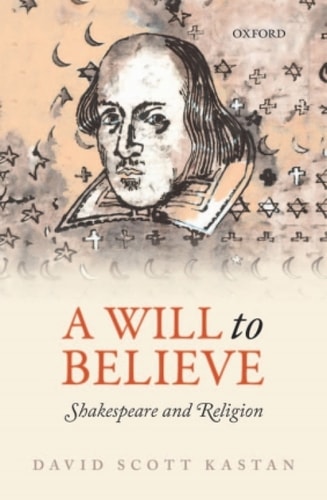
A Will to Believe: Shakespeare and Religion
0
0
As an Amazon Associate and affiliate partner, Menrva Books earns from qualifying purchases. Learn more
Author Description
On 19 December 1601, John Croke, then Speaker of the House of Commons, addressed his colleagues: "If a question should be asked, What is the first and chief thing in a Commonwealth to be regarded? I should say, religion. If, What the second? I should say, religion. If, What the third? I should still say, religion." But if religion was recognized as the "chief thing in a Commonwealth," we have been less certain what it does in Shakespeare's plays. Written and performed in a culture in which religion was indeed inescapable, the plays have usually been seen either as evidence of Shakespeare's own disinterested secularism or, more recently, as coded signposts to his own sectarian commitments. Based upon the inaugural series of the Oxford-Wells Shakespeare Lectures in 2008, A Will to Believe offers a thoughtful, surprising, and often moving consideration of how religion actually functions in them: not as keys to Shakespeare's own faith but as remarkably sensitive registers of the various ways in which religion charged the world in which he lived. The book shows what we know and can't know about Shakespeare's own beliefs, and demonstrates, in a series of wonderfully alert and agile readings, how the often fraught and vertiginous religious environment of Post-Reformation England gets refracted by the lens of Shakespeare's imagination.
Menrva's Summary
THE THESIS
This work investigates how the pervasive religious climate of Post-Reformation England informs the dramatic structure and thematic content of Shakespeare's plays. David Scott Kastan, a distinguished scholar of early modern literature, draws upon historical context and textual analysis to argue that the plays function as sensitive registers of religious experience rather than as indicators of the author's personal sectarian commitments. He challenges the binary view of Shakespeare as either a secularist or a closeted adherent to a specific faith, proposing instead that the plays reflect the complex, often contradictory religious environment of the era.
THE SCOPE MAP
What You Will Find
- Analysis of the religious landscape in late 16th and early 17th-century England
- Close readings of selected Shakespearean plays
- Examination of the intersection between political authority and religious practice
- Historical context derived from the inaugural Oxford-Wells Shakespeare Lectures
Scope Limits
- Does not attempt to definitively identify Shakespeare's private religious beliefs
- Does not provide a comprehensive theological history of the period
THE AUTHORITY PERSPECTIVE
Scholars and students of Shakespeare frequently cite this text for its nuanced approach to the contentious debate surrounding the playwright's religious orientation. The prose is noted for its academic rigor while remaining accessible to those interested in the cultural history of the English Renaissance.
Page Count:
176
Publication Date:
2014-01-01
Publisher:
OUP Oxford
ISBN-10:
0191004294
ISBN-13:
9780191004292
History
Early Modern
Humanities
Special Topics
Theatre
Literary Criticism
Religious History
Community Tags
Similar Books