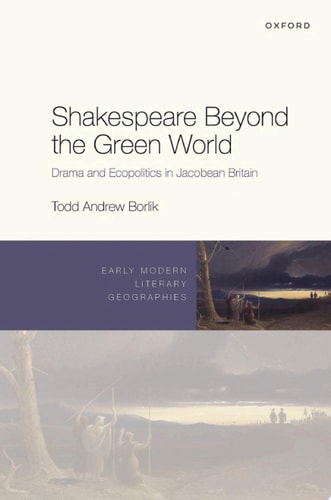
Shakespeare Beyond the Green World: Drama and Ecopolitics in Jacobean Britain
0
0
As an Amazon Associate and affiliate partner, Menrva Books earns from qualifying purchases. Learn more
Author Description
Unpicking the ecopolitics of Shakespeare's plays at the Stuart court, Shakespeare Beyond the Green World establishes that the playwright was remarkably attentive to the environmental issues of his era. As a court dramatist, he designed his plays to captivate a patron deeply involved in both the conservation and exploitation of a burgeoning empire's natural resources. Spurred by James' campaign to unify his kingdoms, the Jacobean Shakespeare ventures beyond the green and pleasant lowlands of England to chart the wild topographies of an expansionist Great Britain: the blasted heath in Macbeth, the caves and mines of Timon of Athens, the overfished North Sea in Pericles, the Welsh mountains in Cymbeline, the Arctic fur country in The Winter's Tale, the fens in The Tempest, overcrowded London and empty Ulster in Measure for Measure and Coriolanus, and the night in Antony and Cleopatra and King Lear. While these plays often simulate a monarch's-eye-view of the natural world, they also reveal that Crown policies were fiercely contested from below. In addition to trekking beyond verdant landscapes, Shakespeare Beyond the Green World seeks to mitigate the Anglocentric and anthropocentric bias of the archive by putting the plays into conversation with texts in which the subaltern wild growls back. Combining deep dives into environmental history with close readings of Shakespearean wordplay, original typography, and original performance conditions, this study re-wilds the Renaissance stage. It spotlights Shakespeare's tendency to humanize beasts and bestialize allegedly godlike monarchs, debunking fantasies of human exceptionalism. By clarifying how the Jacobean plays expose monarchical dominion as ecological tyranny, this study remains scrupulously historicist while reasserting Shakespearean drama's scorching relevance in the Anthropocene.
Menrva's Summary
THE THESIS
This study investigates how Shakespeare’s Jacobean plays function as critiques of environmental exploitation and monarchical power within the context of early seventeenth-century British expansionism. Todd Andrew Borlik, a scholar of early modern literature, utilizes a historicist framework to examine the intersection of ecological policy and dramatic performance. By analyzing the plays alongside contemporary environmental records, the author argues that Shakespeare’s work actively challenged the anthropocentric and Anglocentric ideologies of the Stuart court.
THE SCOPE MAP
What You Will Find
- Analysis of environmental themes in plays including Macbeth, The Tempest, and King Lear.
- Examination of Jacobean policies regarding land use, resource extraction, and colonial expansion.
- Integration of environmental history with close readings of Shakespearean wordplay and performance conditions.
Scope Limits
- The study focuses primarily on the Jacobean period and does not provide an exhaustive analysis of the entire Shakespearean canon.
- The text prioritizes political and ecological readings over purely aesthetic or character-driven interpretations.
THE AUTHORITY PERSPECTIVE
Scholars in the field of ecocriticism recognize this work as a significant contribution to the study of early modern environmental thought. Readers frequently note the academic density of the prose and the author's meticulous archival research.
Page Count:
304
Publication Date:
2022-01-01
Publisher:
OUP Oxford
ISBN-10:
0192691880
ISBN-13:
9780192691880
Ecocriticism
Humanities
Theatre
English literature
Literary Criticism
Special Topics
Early Modern
Political History
Environmental History
Community Tags
Similar Books