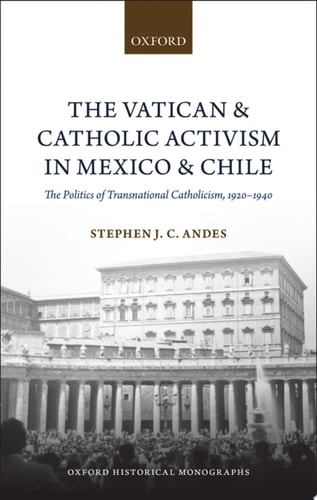
The Vatican and Catholic Activism in Mexico and Chile: The Politics of Transnational Catholicism, 1920-1940
0
0
As an Amazon Associate and affiliate partner, Menrva Books earns from qualifying purchases. Learn more
Author Description
As in Europe, secular nation building in Latin America challenged the traditional authority of the Roman Catholic Church in the early twentieth century. In response, Catholic social and political movements sought to contest state-led secularisation and provide an answer to the 'social question', the complex set of problems associated with urbanisation, industrialisation, and poverty. As Catholics mobilised against the secular threat, they also struggled with each other to define the proper role of the Church in the public sphere. This study utilizes recently opened files at the Vatican pertaining to Mexico's post-revolutionary Church-state conflict known as the Cristero Rebellion (1926-1929). However, looking beyond Mexico's exceptional case, the work employs a transnational framework, enabling a better understanding of the supranational relationship between Latin American Catholic activists and the Vatican. To capture this world historical context, Andes compares Mexico to Chile's own experience of religious conflict. Unlike past scholarship, which has focused almost exclusively on local conditions, Andes seeks to answer how diverse national visions of Catholicism responded to papal attempts to centralize its authority and universalize Church practices worldwide. The Politics of Transnational Catholicism applies research on the interwar papacy, which is almost exclusively European in outlook, to a Latin American context. The national cases presented illuminate how Catholicism shaped public life in Latin America as the Vatican sought to define Catholic participation in Mexican and Chilean national politics. It reveals that Catholic activism directly influenced the development of new political movements such as Christian Democracy, which remained central to political life in the region for the remainder of the twentieth century.
Menrva's Summary
THE THESIS
This study investigates how the Vatican sought to centralize authority and influence national politics in Mexico and Chile during the interwar period of 1920 to 1940. Stephen J. C. Andes, a historian specializing in Latin American religious and political movements, utilizes newly accessible Vatican archives and comparative national analysis to argue that Catholic activism in these regions was not merely a local reaction to secularization but a complex negotiation with supranational papal directives. By examining the Cristero Rebellion and Chilean religious conflicts, the author demonstrates how these interactions laid the groundwork for the emergence of Christian Democracy in Latin America.
THE SCOPE MAP
What You Will Find
- Comparative analysis of Church-state relations in Mexico and Chile between 1920 and 1940.
- Examination of the Vatican's efforts to standardize and centralize Catholic political participation globally.
- Insights into the origins of Christian Democratic political movements in the region.
- Primary source research derived from recently opened Vatican files and regional archives.
Scope Limits
- The study focuses primarily on the influence of the Vatican and does not provide an exhaustive history of all secular political parties in Mexico or Chile.
- The analysis is bounded by the 1920-1940 timeframe and does not extend into the post-WWII era.
THE AUTHORITY PERSPECTIVE
Scholars recognize this work as a significant contribution to the field of transnational religious history, particularly for its successful integration of Latin American case studies into the broader narrative of the interwar papacy. Readers frequently note the academic density of the prose and the author's meticulous use of archival evidence to challenge previous scholarship that focused solely on local conditions.
Page Count:
266
Publication Date:
2014-01-01
Publisher:
OUP Oxford
ISBN-10:
019100216X
ISBN-13:
9780191002168
History
American History
Catholicism
Catholics
Religious History
Transnational Studies
Chile history
Community Tags
Similar Books