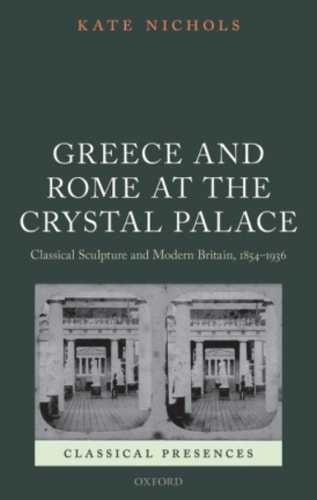
Greece and Rome at the Crystal Palace: Classical Sculpture and Modern Britain, 1854-1936
0
0
As an Amazon Associate and affiliate partner, Menrva Books earns from qualifying purchases. Learn more
Author Description
The marble halls of the British Museum might seem the natural habitat for classical sculpture, but in the nineteenth century its sombre displays were far from being the only place that people encountered antiquities. From 1854, a rival collection of classical sculpture, comprising plaster casts from major European museums and scaled down architectural features, was on show in the South London suburb of Sydenham, in the Crystal Palace which had housed the Great Exhibition of 1851. By the late 1850s, two million visitors were passing through the glass doors of the Sydenham Crystal Palace each year, more than twice as many as recorded at the British Museum. Many more people, and from a greater variety of social strata, saw the painted cast of the Parthenon frieze in Sydenham than the original in Bloomsbury. Utilizing an extensive variety of archival material, including diaries, scrapbooks and photographs, Greece and Rome at the Crystal Palace evokes visitor experiences at Sydenham, and examines the discussion that arose around the presentation of classical plaster casts to a mass audience. It uncovers the social, political, and aesthetic role of ancient Greek and Roman sculpture in modern Britain, assessing how classical art figured in debates over design reform, taste, beauty and morality, class and gender, and race and imperialism.
Menrva's Summary
THE THESIS
This book investigates how the display of classical plaster casts at the Crystal Palace in Sydenham shaped public engagement with antiquity and influenced Victorian social and aesthetic values. Kate Nichols, a scholar of nineteenth-century visual culture, utilizes a diverse array of archival sources—including personal diaries, photographs, and scrapbooks—to reconstruct the visitor experience. She argues that the Crystal Palace functioned as a critical site for democratizing access to classical art, thereby fueling broader societal debates regarding morality, class, gender, and imperial identity in modern Britain.
THE SCOPE MAP
What You Will Find
- Analysis of the Crystal Palace as a primary venue for classical sculpture between 1854 and 1936.
- Examination of the role of plaster casts in design reform and aesthetic education.
- Investigation into the intersection of classical art with Victorian concepts of race, gender, and social status.
Scope Limits
- The study focuses specifically on the Sydenham site and does not provide a comprehensive history of the British Museum or other national collections.
- The analysis is bounded by the years 1854 to 1936 and does not extend into post-war cultural developments.
THE AUTHORITY PERSPECTIVE
Scholars in the field of classical reception studies recognize this work as a significant contribution to understanding how nineteenth-century audiences interacted with ancient art outside of traditional museum spaces. Readers frequently note the meticulous archival research and the clarity with which the author connects aesthetic display to the political climate of the era.
Page Count:
328
Publication Date:
2015-01-01
Publisher:
OUP Oxford
ISBN-10:
0191016918
ISBN-13:
9780191016912
History
London England
Museum Studies
British History
Humanities
Art History
Sculpture
Community Tags
Similar Books